Campbell Bay National Park:
Where India Touches the Endless Ocean in Perfect Ecological Harmony
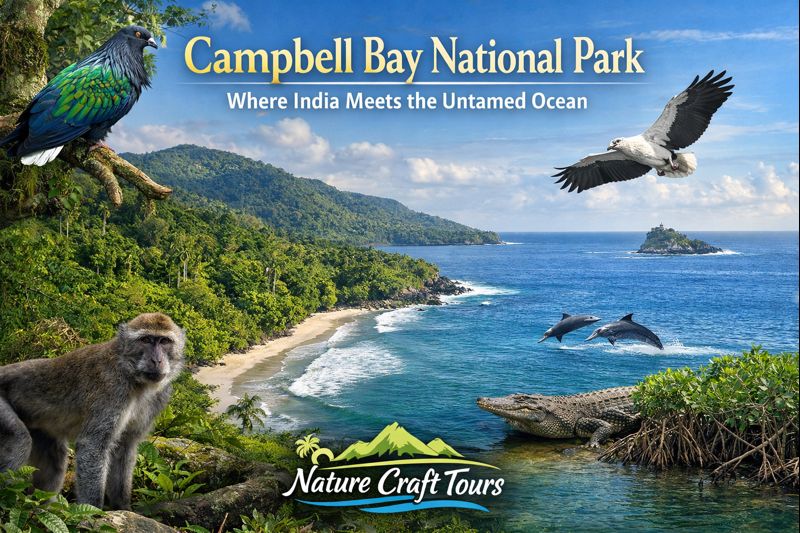
At the farthest southern edge of the Indian subcontinent, where land gradually surrenders to the vastness of the Indian Ocean, lies a protected realm of remarkable ecological integrity—Campbell Bay National Park. This remote wilderness, located in the Great Nicobar Island of the Andaman and Nicobar archipelago, stands as a living testament to nature’s ability to maintain balance when left undisturbed. Here, untouched rainforests, rare endemic wildlife, and the rhythmic pulse of open ocean coexist in profound harmony, forming one of India’s least explored yet most scientifically significant natural landscapes.
A Geographical Threshold Between Continent and Ocean
Campbell Bay National Park occupies a unique geographical position that sets it apart from all other protected areas in India. Situated close to the equator, the park experiences an equatorial maritime climate marked by high humidity, consistent temperatures, and abundant rainfall throughout the year. This climatic stability has allowed complex rainforest ecosystems to evolve uninterrupted for millennia.
The park’s southern boundary faces the open Indian Ocean, while its interior rises gradually into forested hills and plateaus. This transition from coastal ecosystems to dense tropical rainforest within a compact geographical space creates an extraordinary ecological gradient. Mangrove belts, coastal forests, evergreen rainforests, and inland hill forests merge seamlessly, allowing species to move freely across habitats in response to seasonal changes.
An Island Ecosystem Shaped by Isolation
Great Nicobar’s isolation from the mainland has played a decisive role in shaping the biodiversity of Campbell Bay National Park. Over thousands of years, plants and animals adapted independently, resulting in high levels of endemism. Species found here often exist nowhere else on Earth, making the park invaluable for evolutionary and conservation research.
This isolation has also preserved ecological processes that have disappeared from more accessible landscapes. Natural regeneration, predator-prey balance, and forest succession occur here with minimal human interference, offering scientists a rare opportunity to study pristine tropical ecosystems.
Rainforests That Breathe With the Sea
The rainforests of Campbell Bay National Park are dense, multi-layered, and extraordinarily rich in plant life. Towering evergreen trees form a closed canopy that filters sunlight into a soft green glow, while beneath them thrive lianas, epiphytes, orchids, and ferns. The forest floor remains damp and fertile year-round, supporting continuous nutrient recycling.
Unlike continental rainforests, these island forests are intimately influenced by the surrounding ocean. Saline winds, monsoon-driven rainfall, and tidal patterns shape vegetation structure and species composition. Coastal forests transition into mangroves that act as natural buffers, protecting inland ecosystems from storm surges and erosion.
Botanical Diversity and Ecological Functions
The flora of the park plays a critical role in climate regulation and carbon sequestration. Large canopy trees store vast amounts of carbon, while mangrove systems trap sediments and support marine productivity. These forests also regulate freshwater flow, ensuring that streams and wetlands remain functional even during dry periods.
Such ecological services extend far beyond the park’s boundaries, contributing to regional climate stability and marine health across the eastern Indian Ocean.
Rare Wildlife at the Edge of Survival
Campbell Bay National Park shelters a remarkable array of wildlife, much of it rare, elusive, and highly adapted to island life. Mammals, reptiles, birds, and insects coexist within tightly interlinked food webs. Many species display behavioral and physical traits shaped by limited territory and specialized diets.
Birdlife is particularly notable, with several endemic species relying on intact forest canopies and undisturbed nesting sites. Reptiles, including large monitor lizards and diverse snake species, play a vital role in maintaining ecological balance by regulating prey populations.
Marine and Terrestrial Interdependence
What distinguishes Campbell Bay National Park is the seamless connection between land and sea. Coastal waters support coral reefs and marine life that influence terrestrial ecosystems through nutrient exchange. Seabirds transport marine nutrients inland, enriching forest soils, while mangroves provide nursery grounds for fish that sustain oceanic food chains.
This land-sea interface mirrors ecological dynamics found in regions such as the Sundarbans, where forest and water exist in mutual dependence. Travelers interested in similar ecosystem interactions may explore a Sundarban Tour to experience another of India’s globally significant natural landscapes.
Conservation Significance and Scientific Value
The conservation value of Campbell Bay National Park extends beyond its boundaries. As one of India’s least disturbed protected areas, it serves as a benchmark for understanding natural ecosystem function in tropical island environments. Data collected here informs climate models, biodiversity assessments, and long-term conservation planning.
The park also forms part of a broader conservation network within the Andaman and Nicobar Islands. Nearby protected areas, such as Galathea Bay National Park, collectively safeguard critical habitats for terrestrial and marine species, ensuring ecological continuity across the region.
Challenges and Protective Measures
Despite its remoteness, Campbell Bay National Park faces emerging threats from climate change, sea-level rise, and extreme weather events. Rising ocean temperatures affect coral ecosystems, while intensified storms increase erosion along the coastline. Conservation strategies therefore focus on habitat resilience, scientific monitoring, and strict regulation of human activity.
Protected area status has ensured that large-scale development remains prohibited, preserving ecological integrity for future generations.
Experiencing Wilderness Without Disturbance
Visitation to Campbell Bay National Park is highly regulated, reflecting the priority placed on conservation over tourism. This controlled access ensures that ecosystems remain undisturbed while allowing limited opportunities for scientific research and nature observation.
For travelers seeking marine biodiversity in the region, Mahatma Gandhi Marine National Park offers insights into coral reef ecosystems that complement the terrestrial wilderness of Campbell Bay.
Ethical Travel and Ecological Awareness
Understanding places like Campbell Bay National Park fosters a deeper appreciation for ecological limits and responsibilities. Ethical travel emphasizes observation, education, and respect rather than consumption, aligning human curiosity with conservation objectives.
Similar principles guide nature-based experiences in other fragile ecosystems, including the Sundarbans. Responsible planning through platforms such as Sundarban Travel reflects the growing global commitment to sustainable exploration.
A Poetic Reflection on Nature’s Southern Sanctuary
Beyond science and conservation, Campbell Bay National Park resonates on an emotional level. Its silence carries the weight of ancient forests, its waves whisper stories older than civilization, and its wildlife moves with a quiet assurance born of timeless balance.
Here, the land does not dominate the sea, nor does the ocean overwhelm the forest. Instead, both exist in respectful dialogue, reminding humanity of a world where balance is not enforced but naturally achieved.
From the Edge of India
Where forests lean to hear the ocean speak,
And roots drink whispers of the tidal deep,
The southern wind carries unbroken songs,
Of ancient rain and wandering light.
Here, leaves remember every storm,
And waves bow gently to the shore.
No voice commands, no path intrudes,
Only balance breathes between earth and blue.
At India’s edge, the world feels whole,
Where silence guards the soul of nature.
Preserving Balance at the End of the Land
Campbell Bay National Park stands not merely as a geographical extremity, but as a philosophical reminder of harmony achieved through restraint. Its untouched rainforests, rare wildlife, and open ocean form a living equilibrium that modern societies strive to rediscover.
In protecting such landscapes, humanity safeguards more than biodiversity—it preserves wisdom written in wind, water, and wilderness. At India’s southernmost edge, Campbell Bay remains a quiet guardian of balance, inviting reflection rather than conquest.