Updated: 19 April 2026
Dehing Patkai National Park: The Amazon of the East
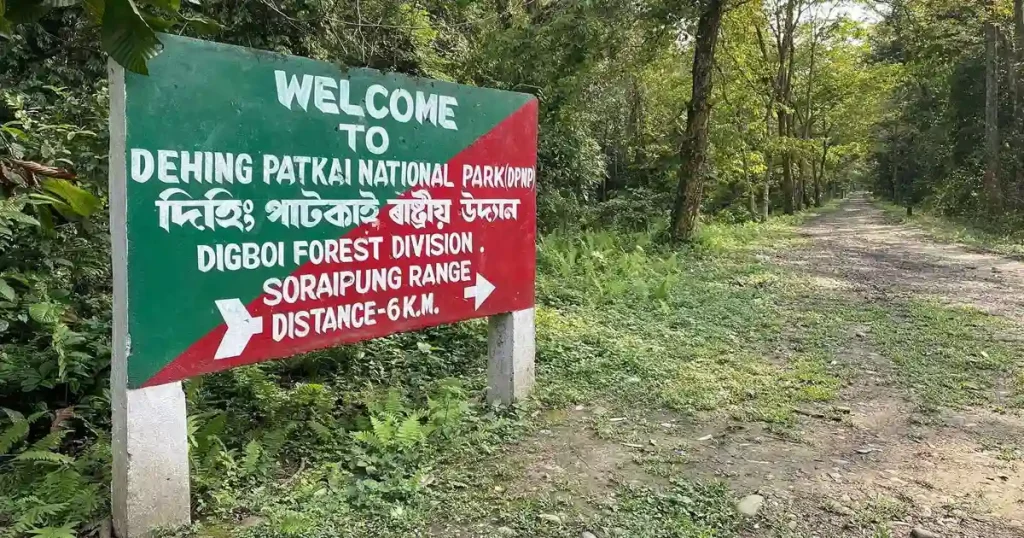
Dehing Patkai National Park is one of the most unusual forest landscapes in India. Located in the eastern part of Assam, this protected rainforest is often called the Amazon of the East because of its dense greenery, humid atmosphere, layered vegetation, and extraordinary biodiversity. The comparison is not simply poetic. The forest has the same feeling of depth and enclosure that tropical rainforest landscapes create elsewhere in the world. Light filters slowly through the upper canopy, the ground remains moist for long stretches, vines and epiphytes occupy multiple levels of the forest, and even short walks can feel immersive and almost cinematic. It is a national park that appeals not only to wildlife tourists, but also to readers of landscape, birders, botanists, ecologists, photographers, and travelers who value silence more than spectacle.
Spread across the districts of Dibrugarh, Tinsukia, and Sivasagar, Dehing Patkai is Assam’s seventh national park and one of the last significant remaining stretches of lowland tropical rainforest in India. Unlike parks known mainly for grassland megafauna or dry forest safaris, Dehing Patkai offers a different type of encounter. It is not a place of guaranteed sightings around every bend. It is a place where forest texture matters, where sound becomes a guide, where movement in the leaves can be more revealing than an open view, and where ecological richness is felt even when animals remain hidden. That depth is exactly what makes the park special.
For nature-focused travelers, Dehing Patkai is important because it preserves a rare rainforest ecosystem in mainland India, supports rich birdlife, protects habitat for elusive mammals, and connects ecological processes shaped by hills, rivers, wetlands, and evergreen forest.
History and Overview
Dehing Patkai received national park status in 2021, but its ecological importance was recognized long before that formal declaration. The broader forested region had already been known to conservationists, researchers, and local communities as one of Assam’s most valuable natural landscapes. Its national park designation gave stronger identity and higher visibility to an area that had long been under pressure from extraction, land-use change, and competing development interests. The park’s conservation story therefore is not only about legal notification. It is also about the recognition that some landscapes are too ecologically significant to be treated as ordinary resource zones.
The name Dehing Patkai itself reflects geography. The Dehing River influences the hydrology and ecological character of the area, while the Patkai hill system shapes the eastern landscape transition. Together they create a setting where lowland rainforest, wet forest, and hill-influenced ecological gradients interact. This matters because biodiversity in tropical regions often increases where landscape variation produces different habitat niches over short distances.
In a wider context, the park forms part of the Indo-Burma biodiversity region, one of the most important global areas for biological richness and ecological endemism. That position increases its conservation value. A protected rainforest in this zone is not merely locally important. It contributes to the survival of species, habitat processes, and gene pools that extend beyond one administrative boundary.
Landscape, Terrain, and Ecosystem Character
The character of Dehing Patkai is defined by rainforest structure rather than by sweeping open views. It is a lowland tropical forest landscape influenced by heavy rainfall, river systems, moist soil, and gradual topographic transition toward the Patkai hills. The terrain includes forested tracts, damp ground, seasonal streams, low-lying wet patches, and zones of dense undergrowth that can change texture within short walking distances. In some places the forest feels closed and heavy with moisture; in others, river edges and secondary growth create brief openings that attract birds, butterflies, and smaller mammals.
One of the most important ecological features of the park is its vertical complexity. This is not a single-layer forest. It contains an upper canopy of tall trees, a middle level of branching vegetation, a shrub layer, climbers, saplings, ferns, and a biologically active forest floor. Such layering increases habitat diversity because different species occupy different heights. Arboreal mammals use branches and canopy routes, hornbills move across fruiting trees, reptiles use ground cover or tree hollows, and insects thrive in constantly humid microhabitats.
Hydrology shapes the park in quieter but equally decisive ways. Rainfall, stream flow, river influence, and moisture retention determine where plant communities flourish and where animals move. Waterlogged ground in wet months changes the practicality of movement for visitors and wildlife alike. Small seasonal channels may look minor in the dry season, but they affect soil moisture, insect activity, and vegetation patterns across broader stretches of forest.
Flora
The flora of Dehing Patkai is one of its greatest strengths. The park contains tropical evergreen, semi-evergreen, and wet evergreen forest types, producing a vegetation profile that feels deep, lush, and layered throughout much of the year. Towering trees such as hollong, nahor, and mekai help define the forest canopy. These species do not merely contribute beauty. They create shade, regulate humidity, support nesting and feeding behavior, and shape the structure of the habitat below them.

Hollong is especially significant in Assam’s forest identity and is often associated with strong, tall evergreen growth. In a rainforest setting, large canopy trees act as both architecture and ecological infrastructure. Their crowns mediate sunlight, their trunks host mosses and climbers, and their fruiting or flowering cycles influence bird and mammal movement. Nahor contributes visual richness and structural diversity, while other tall rainforest trees create a canopy that rarely feels still.


The lower layers are equally important. Ferns thrive in moist shade, orchids add botanical richness, and climbing plants create the woven density that gives the rainforest its closed appearance. Mosses, leaf litter, fungi, and decomposing wood together make the forest floor highly productive. In tropical systems, decay is not a sign of emptiness. It is part of the living cycle. Fallen branches quickly become insect habitat, fungal substrate, and nutrient source.
- Dominant vegetation includes evergreen and wet evergreen forest.
- Large trees create shade-rich canopy conditions.
- Ferns, orchids, climbers, and moisture-loving plants enrich the understory.
- Seasonal humidity keeps the forest visually green and biologically active.
Fauna
Dehing Patkai supports an impressive range of animal life, but the forest does not reveal its residents easily. Wildlife in rainforest environments often survives through concealment, arboreal movement, sound awareness, and irregular visibility. That makes the fauna of Dehing Patkai especially exciting for serious observers. The park is associated with rare and elusive species such as the clouded leopard, along with Bengal tiger, Assamese macaque, and Asiatic black bear. These species represent different ecological levels of the forest, from ground and mid-level use to canopy-linked movement and predator behavior.




The clouded leopard, in particular, gives the park global conservation interest. It is one of the most elusive and visually striking forest cats in Asia, better adapted to dense woodland than open country. Its presence suggests the persistence of habitat depth and structural integrity. Bengal tiger presence adds another layer of ecological significance, even though sightings are naturally rare in this kind of forest. Top predators matter because they indicate the broader functioning of the food web.
Primates such as Assamese macaques bring movement and sound into the forest. They may be among the more noticeable mammals because of their social nature and canopy use. Asiatic black bear adds further ecological interest, while smaller mammals, civets, squirrels, and nocturnal life likely contribute significantly to the less visible biodiversity of the park.

Birdlife is a major strength of Dehing Patkai, with over 300 bird species associated with the park and surrounding forested landscape. Hornbills are among the most charismatic birds here. In rainforest ecosystems, hornbills are not just attractive sightings. They are important seed dispersers and part of the long-term regeneration story of the forest. Raptors, forest birds, canopy frugivores, insectivores, and edge species together create excellent birding potential across seasons.

The reptile life of the park includes snakes such as the king cobra, along with turtles and other forest reptiles. Amphibians and insects also deserve attention. Rainforests are often rich in frogs, moths, beetles, and butterfly life, especially where humidity stays high and plant diversity is strong. Butterflies are not a minor detail here. They are visible indicators of habitat health and microclimatic richness.
Wildlife Experience and Field Observation Value
Visitors should approach Dehing Patkai with the right expectations. This is not a national park where open visibility makes wildlife easy to scan from long distances. Forest sightings here depend on patience, silence, timing, and careful attention to movement, calls, and habitat edges. A shaking branch, a sharp alarm call, a sudden silence among birds, or a movement across a trail may reveal more than a prolonged search through dense cover.
Morning and late afternoon usually provide the best field conditions. During these periods, temperatures are lower, forest sound is more active, and animal movement can increase. Rainfall, humidity, and light angle influence what can be observed. After rain, insects, frogs, and certain birds may become more noticeable. In drier windows, trails may be easier to use and the forest floor slightly more readable.
In Dehing Patkai, the experience of observation often includes listening as much as looking. Calls, wingbeats, branch movement, and forest silence all become part of how wildlife is understood.
Birdwatching Significance
For birdwatchers, Dehing Patkai is one of the most rewarding forest landscapes in Northeast India. The combination of evergreen forest, river-linked edges, moist habitat, and varied forest levels creates strong conditions for bird diversity. Some birds remain high in the canopy and are identified first by call, while others are more active near edges, clearings, or fruiting trees. Birding here requires patience and often benefits from a local guide who knows seasonal patterns, feeding trees, and call-based identification points.
Hornbills are among the highlight species because they embody the scale and vitality of rainforest birdlife. Their presence indicates the availability of large trees and suitable nesting conditions. Raptors and eagles contribute to the park’s upper trophic birdlife, while smaller species animate the mid-level and understory. The value of the park to birders lies not only in a species list, but in the quality of habitat and the interpretive depth it offers.
Main Attractions
Wildlife Safaris and Forest Exploration
Wildlife exploration in Dehing Patkai is best understood as rainforest field experience rather than classic open safari. The attraction lies in entering a rare habitat, reading its signs, and moving through a biologically dense landscape. Even when large mammals remain hidden, the sense of being inside an old, moist forest is powerful.
Dehing River and Associated Trails
River-linked stretches add scenic relief to the forest experience. The Dehing River and adjacent moist zones influence birdlife, vegetation pattern, and landscape mood. Trails near riverine sections can offer photography opportunities, especially in softer morning light.
Butterfly Observation
The park’s humidity, plant diversity, and light gaps make it especially interesting for butterfly observation. Butterflies often concentrate near damp patches, edges, and sunlit openings. For many visitors, these colorful movements become some of the most memorable visual details of the forest.
Tea Landscapes and Ethnic Settlements Nearby
The surrounding human landscape gives additional context to the visit. Tea gardens, small settlements, and culturally distinct communities around the park create a wider regional identity. For travelers, this offers a fuller understanding of how forest, livelihood, and regional history intersect in eastern Assam.
Tribal, Cultural, or Human Landscape Context
The areas surrounding Dehing Patkai are associated with communities such as the Tai-Phake, Singpho, and Khamti, along with other local populations shaped by tea, trade, agriculture, and forest proximity. Their presence reminds visitors that protected landscapes are rarely isolated from human history. Forest-edge communities often carry generations of ecological familiarity, seasonal knowledge, and livelihood adaptation linked to the landscape.
Visitors should approach nearby settlements with respect, curiosity, and restraint. Cultural observation is meaningful when it is not intrusive. Local identity in this region is tied to language, food, craft traditions, tea-growing landscapes, Buddhist influences in some pockets, and long-standing patterns of coexistence with humid forest environments.
Best Time to Visit
The best time to visit Dehing Patkai National Park is generally from October to April. This broad window includes post-monsoon freshness, winter comfort, and spring vitality. Each part of the season offers something slightly different, and travelers can choose according to interest.
- October to November: The forest remains lush after monsoon, streams retain moisture, and the landscape feels particularly green and fresh.
- December to February: Cooler and more comfortable weather makes travel easier, especially for longer field hours and birdwatching.
- March to April: Good for visitors who enjoy active forest soundscapes, flowering phases, and stronger butterfly and birding interest.
The monsoon period from June to September usually brings heavy rain, wet ground, trail difficulty, and operational limitation. In a rainforest park, monsoon is ecologically powerful but practically restrictive. Roads can be affected, movement becomes difficult, and visitor safety considerations increase.
Timings, Entry Rules, Permits, and Visitor Regulations
The park is generally open from 6:00 AM to 5:00 PM, and it usually remains accessible through the main visitor season. However, weather and forest conditions can influence operational practicality. Protected landscapes are not amusement spaces. Timing rules exist because wildlife activity, safety, daylight, and management capacity all matter.
- Opening Hours: 6:00 AM to 5:00 PM
- Weekly Operation: Usually open through the week during the visitor season
- Seasonal Closure: Monsoon period, especially June to September, may restrict or suspend visitation
- Permit Readiness: Visitors should carry valid identification and check current local procedure before arrival
- Guide Dependence: Guided access may be required or strongly recommended in sensitive forest areas
- Photography: Camera fees may apply; always follow local rules regarding restricted areas and wildlife disturbance
Rules matter in Dehing Patkai because dense rainforest habitats are fragile. Noise, litter, off-trail movement, and careless photography can disturb animals, damage microhabitats, and reduce the quality of the forest experience for everyone.
Ticket Fees and Booking Process
The fee structure mentioned in the original article should be preserved for planning reference, though travelers should always verify the latest pricing before travel.
- Indian Nationals: ₹100 per person
- Foreign Nationals: ₹500 per person
- Camera Fees: ₹50 for still cameras and ₹200 for video cameras
- Vehicle Entry: ₹300 per vehicle
Visitors can generally book online or obtain access at the entry point, depending on current forest department arrangements. Advance planning is wiser during busier months because it reduces uncertainty, especially for travelers coming from Dibrugarh, Tinsukia, or farther away.
- Visit the Assam Forest Department website or current official booking source.
- Select Dehing Patkai National Park or relevant visitor entry option.
- Fill in date, visitor details, and ID information.
- Pay the fee and save the confirmation.
- Carry digital and physical copies where possible.
Travelers arranging a broader itinerary may also use authorized operators for logistics, accommodation, and local guidance. This can be especially helpful for first-time visitors unfamiliar with the area.
How to Reach
By Air
The nearest airport is Dibrugarh Airport, approximately 70 km from the park. From the airport, travelers usually continue by hired car or taxi. The final stretch is not simply about distance; it depends on road condition, destination point near the park, and seasonal weather.
By Train
Tinsukia Railway Station, about 40 km away, is the most practical rail entry point for many visitors. Dibrugarh also works well as a broader transport hub. From the station, travelers usually hire taxis or arrange pick-up in advance.
By Road
Dehing Patkai is accessible by road from Tinsukia, Dibrugarh, Digboi, and Guwahati through longer overland connections. The practical reality is that private transport or arranged vehicle travel gives the most comfort and flexibility, especially if luggage, photography equipment, or family travel is involved.
- Nearest major approach hubs: Dibrugarh and Tinsukia
- Shorter transfers are easier in the dry season
- Monsoon can slow road travel considerably
- Early departure is useful to match morning entry timing
Accommodation and Stay Planning
Accommodation planning for Dehing Patkai should be practical rather than overly luxurious in expectation. Depending on the exact travel style and access point, visitors may choose from lodges, guesthouses, eco-stays, and town-based hotels in nearby hubs such as Tinsukia, Digboi, Dibrugarh, or other local centers.
- Forest-side or eco-oriented stays: Better for early starts and immersive atmosphere
- Town hotels: Better for comfort, transport availability, and predictable facilities
- Guesthouses: Useful for budget and short-stay travel
- Advance booking: Recommended during peak winter and holiday travel
Travelers should check electricity reliability, meal availability, early tea or breakfast arrangements, and road transfer timing in advance. In remote or forest-edge settings, small practical details matter more than in urban tourism.
What Travelers Should Know Before Going
This is one of the most important planning sections for Dehing Patkai because rainforest travel is rewarding only when expectations and preparation are realistic.
- Carry valid ID proof and keep a backup photocopy or digital copy.
- Wear full-sleeve light clothing suited to humid conditions.
- Use sturdy footwear with grip; trails may be damp or muddy.
- Carry insect repellent, basic medicines, and drinking water.
- Keep some cash because remote travel zones may not always support quick digital payment or easy ATM access.
- Expect patchy mobile network in some pockets.
- Do not depend on casual local transport for return travel late in the day.
- Children can enjoy the park if travel is well-paced, but very young children may find long humid field hours tiring.
- Senior travelers should plan easy access, shorter field sessions, and comfortable transport.
- Solo travelers should keep itinerary details shared with hotel staff or known contacts.
- Responsible photography matters; never push for close wildlife encounters.
- Respect guide instructions because dense forest is harder to read than open habitat.
Dehing Patkai is suitable for travelers who appreciate ecology, forest atmosphere, birding, and slow observation. It may not satisfy those expecting constant dramatic wildlife encounters. Families, researchers, photographers, and thoughtful nature travelers generally value it most when they treat the park as a serious rainforest landscape rather than a quick sightseeing stop.
Important Facts
Dehing Patkai stands out not because it is the largest or most commercial national park, but because it preserves a rare ecological type that has become increasingly fragmented in India. Its value lies in habitat continuity, rainforest structure, hydrological richness, and the presence of elusive species that depend on deep forest conditions.
- Rare Rainforest Ecosystem: It is Assam’s only rainforest national park.
- Lowland Forest Importance: Lowland tropical forest is highly threatened and therefore especially valuable.
- Biodiversity Strength: The park supports birds, reptiles, butterflies, mammals, and complex plant communities.
- Conservation Sensitivity: The surrounding region has faced ecological concern linked to extractive pressure.
- Research Value: Rainforest structure, species interaction, and habitat transition make it important for ecological observation.
Interesting Facts
The wildlife associated with Dehing Patkai reflects the richness of rainforest India. Many of the species linked with this park also occur in other important national parks across the country, but the habitat setting in Dehing Patkai remains distinctive because of its humid lowland rainforest structure. The table below highlights several species connected with the article and shows other Indian national parks where they are also found.
| Wildlife Species | National Parks in India |
|---|---|
| Clouded Leopard | Dehing Patkai, Namdapha, Manas |
| Royal Bengal Tiger | Dehing Patkai, Sundarban, Jim Corbett, Ranthambore, Bandhavgarh, Kanha |
| Asiatic Black Bear | Dehing Patkai, Namdapha, Great Himalayan, Dachigam |
| Assamese Macaque | Dehing Patkai, Manas, Namdapha |
| Great Hornbill | Dehing Patkai, Manas, Namdapha, Kaziranga |
| King Cobra | Dehing Patkai, Periyar, Silent Valley, Nagarhole |
| Forest Turtles | Dehing Patkai, Kaziranga, Orang, Namdapha |
| Butterfly Diversity | Dehing Patkai, Namdapha, Silent Valley, Great Himalayan |
Nearby Attractions
Dehing Patkai can be combined with several nearby destinations that enrich the journey without distracting from the main forest experience.
- Digboi Oil Town: Useful for travelers interested in industrial history and colonial-era legacy in eastern Assam.
- Dibru-Saikhowa National Park: A strong pairing for visitors who want to compare rainforest experience with riverine and wetland-oriented protected landscapes.
- Namphake Buddhist Monastery: Offers a calmer cultural stop and a different atmosphere after forest travel.
- Margherita Town: Adds social and historical context to the region through its mining and settlement background.
Sundarban Connection and Ecological Comparison
At first glance, Dehing Patkai National Park and Sundarban National Park seem very different. One is a humid lowland rainforest in Assam shaped by evergreen forest and hill-linked moisture, while the other is a tidal mangrove landscape in coastal Bengal defined by creeks, mudbanks, saline influence, and estuarine rhythm. Yet there are meaningful ecological comparisons between them, especially for travelers who want to understand how dense, predator-influenced, wet landscapes shape wildlife behavior and visitor experience.
Both parks are places where visibility is limited and reading the environment becomes essential. In Dehing Patkai, foliage, shadow, layered canopy, and undergrowth conceal movement. In Sundarban, creeks, mangrove walls, pneumatophores, mudflats, and tidal channels create a different kind of concealment. In both landscapes, animals are alert because the habitat rewards caution. A forest or mangrove system that supports major predators produces prey species that listen closely, move carefully, and often remain hidden until conditions feel safe.
This is one reason why visitors familiar with Sundarban tour experiences often find Dehing Patkai emotionally recognizable even though the habitat is different. The similarity lies not in outward appearance alone, but in ecological tension. In both places, silence has meaning. Alarm calls matter. Sudden movement at the edge of sight becomes important. Waiting is part of the journey.
There is also a connection through wetness. Sundarban is shaped by tides, saline channels, mudbanks, and river-sea interaction. Dehing Patkai is shaped by rainfall, river influence, moisture retention, and damp forest floor conditions. In each case, water governs movement, vegetation, and habitat use. It affects where animals feed, where birds gather, and how people can enter the landscape. Travelers choosing a Sundarban tour package often notice that routes, timings, and wildlife possibility all depend on water. In Dehing Patkai, the same principle appears in another form through rain-soaked terrain, seasonal access, and forest moisture.
Birdlife also creates a meaningful point of comparison. Sundarban supports estuarine, raptor, kingfisher, and wetland-associated species, while Dehing Patkai supports rainforest birds, hornbills, forest canopy species, and rich insect-linked bird activity. The bird communities are not the same, but in both parks birding becomes one of the most rewarding ways to experience the habitat. Birds often reveal the forest or mangrove before mammals do.
For a traveler interested in ecological reading rather than simple sightseeing, both parks teach a similar lesson: dense natural systems must be entered with humility. In Sundarban, the rhythm comes from tide, creek, and open water corridors. In Dehing Patkai, it comes from canopy, shadow, moisture, and layered vegetation. Anyone who values careful, patient, habitat-based travel will understand why thoughtful Sundarban travel and a journey through Dehing Patkai can feel connected in spirit, even while remaining completely distinct in geography and form.
Tips for Visitors
- Start early to use the best light and coolest field hours.
- Keep clothing neutral and practical rather than bright.
- Carry binoculars if birding or slow wildlife observation matters to you.
- Do not expect constant tiger or large mammal sightings in dense rainforest.
- Move quietly and allow longer pauses during field exploration.
- Avoid plastic waste and bring back all non-biodegradable material.
- Plan transport buffers so that return travel does not become rushed.
- Listen to local guides, especially in weather-sensitive or dense trail zones.
Conclusion
Dehing Patkai National Park is one of those rare destinations where the habitat itself is the main revelation. The rainforest does not perform on command, and that is precisely why it leaves such a lasting impression. It asks visitors to slow down, to look carefully, to listen, and to understand that biodiversity is not always dramatic in a visible way. Sometimes it exists as layered sound, damp air, hidden movement, tree architecture, and patient ecological balance. For travelers who value genuine landscape experience, Dehing Patkai is not just a national park in Assam. It is one of India’s most important surviving rainforest worlds.