Updated: April 19, 2026
Mouling National Park: A Guide to Arunachal Pradesh’s Pristine Wilderness
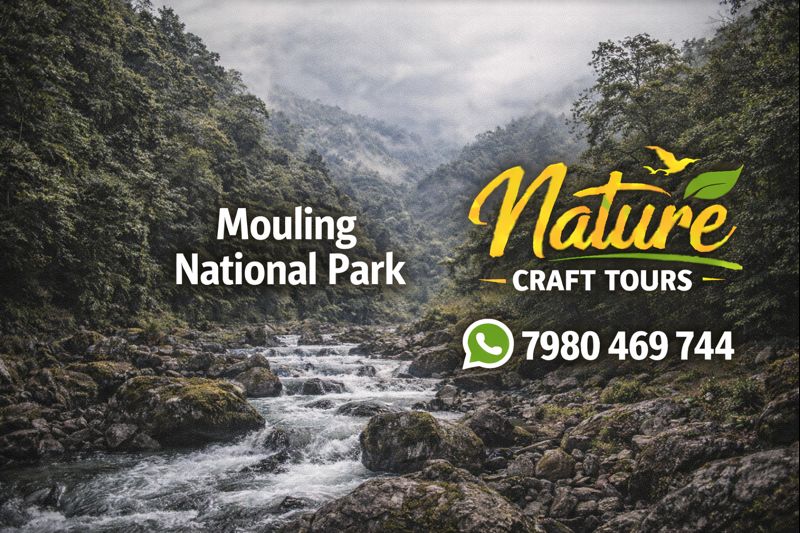
Mouling National Park is one of the least disturbed protected landscapes in Arunachal Pradesh and also one of the least hurried wildlife destinations in India. It does not announce itself with crowded safaris, heavily marked roads, or easy wildlife checklists. Instead, it rewards the traveler who values remoteness, forest texture, changing altitude, mountain weather, river-cut valleys, and the slow rhythm of a living Himalayan ecosystem. Spread across about 483 square kilometers, the park lies primarily in Upper Siang district, with its ecological influence extending across a broader mountain landscape connected to the Dihang-Dibang Biosphere Reserve. In practical terms, Mouling is not merely a sightseeing stop. It is a protected wilderness where geography, climate, vegetation, and wildlife still shape the visitor experience more than tourism infrastructure does.
The name of the park is linked to Mouling Peak, and local Adi understanding of the landscape gives the place a deeper meaning than a map can show. Here, ridges rise above river systems, dense forests shift from tropical and sub-tropical conditions to temperate and higher-altitude vegetation, and animal movement often remains invisible to casual observation. What makes Mouling distinctive is not only its biodiversity, but the way that biodiversity is arranged across elevation, moisture, slope, and isolation. The result is a park with unusually rich habitat variety for its size, making it important to botanists, birdwatchers, conservationists, and travelers who prefer ecological depth over easy entertainment.
Mouling National Park is especially valuable because it represents a transition zone within the Eastern Himalaya, where lower humid forests rise toward temperate and high-elevation habitats. This ecological layering helps support species such as red panda, clouded leopard, hoolock gibbon, serow, goral, hornbills, and highland pheasants in a relatively compact but rugged protected landscape.
History and Overview
Mouling National Park was created in 1986, becoming the second national park established in Arunachal Pradesh after Namdapha. Its creation was an important step in protecting the forests of the Siang region, an area known for difficult terrain, sparse settlement in the core zone, and extremely high biological richness. Because the landscape remained remote and challenging to access, many parts of the park retained a strong ecological integrity even before formal protection. The legal declaration therefore helped preserve an already valuable wilderness rather than attempting to restore a severely altered one.
The park forms the western part of the larger Dihang-Dibang Biosphere Reserve, one of the major conservation landscapes of northeastern India. This is significant because Mouling cannot be understood in isolation. Its streams, ridges, vegetation belts, and wildlife corridors connect it to wider mountain systems and river basins. Species that need large territories, seasonal movement routes, or habitat continuity benefit from this broader ecological setting. In conservation terms, Mouling is important not simply as a fenced unit on paper, but as a functioning part of a larger high-diversity landscape.
The park’s terrain is rugged and strongly folded, with altitudinal variation generally described from around 750 meters to over 3,000 meters above sea level, with Mouling Peak rising to about 3,064 meters. This vertical range creates different climate bands and forest types within a relatively narrow horizontal space. Such ecological compression is one of the reasons the Eastern Himalaya supports extraordinary biodiversity. A traveler moving upward through the landscape can notice shifts in humidity, canopy form, undergrowth density, tree composition, and bird calls. The park is therefore not only a place of wildlife, but also a place of transition.
Landscape, Terrain, and Ecosystem Character
Mouling National Park is shaped by mountain slopes, deeply incised valleys, wet forested ridges, seasonal streams, and the influence of major river systems including the Siang and the Siyom. Several smaller rivers and drainage lines cut through the protected area and feed into larger channels beyond it. These watercourses do more than carry runoff. They create humid microhabitats, influence plant distribution, guide wildlife movement, and affect the accessibility of the landscape. In some stretches, a short change in elevation can transform the feel of the forest from broadleaf humid shade to cooler, more open upper-elevation vegetation.
The slopes are often steep, and the park is not a flat safari environment. This matters greatly for wildlife viewing. In rugged terrain, animals use folds of land, canopy pathways, cliff-edge cover, and dense side valleys to remain concealed. Sound also behaves differently in such terrain. Calls may travel, but direct visibility may remain poor. For the visitor, this means that reading the landscape becomes part of the experience. Fresh movement in leaf litter, alarm calls from birds, sudden silence in a forest patch, or distant branches shaking on a slope may provide as much information as a direct sighting.
Ecologically, Mouling represents a transition from lower tropical and sub-tropical humid forest zones to temperate and higher-altitude habitats. This layering supports species with very different habitat preferences. Arboreal mammals use closed canopy sectors, ungulates move through edge and slope systems, highland birds occupy cooler belts, and predator presence reflects prey availability across terrain types. Because the park is extremely humid and receives heavy rainfall, vegetation remains thick and productive across much of the year. Even where the forest appears still, it is structurally complex, with vines, bamboo patches, moss, epiphytes, leaf litter, fallen trunks, and understory cover all contributing to habitat richness.
Travelers should think of Mouling as a mountain forest ecosystem rather than a conventional national park with easy loops and fixed viewing circuits. The experience is shaped by gradient, moisture, silence, and patience.
Flora
One of the great strengths of Mouling National Park is the way its plant life changes with altitude. The lower areas support tropical evergreen and sub-tropical broadleaf forests with thick green structure, climbing vegetation, ferns, and a generally humid, enclosed feel. As one moves higher, the composition gradually shifts toward cooler forest communities, including oak-rich belts, patches of bamboo, rhododendron, and other montane vegetation. In upper reaches, the landscape begins to show a more temperate and alpine character. This progression is not merely scenic. It creates different food resources, nesting opportunities, canopy architecture, and cover conditions for wildlife.


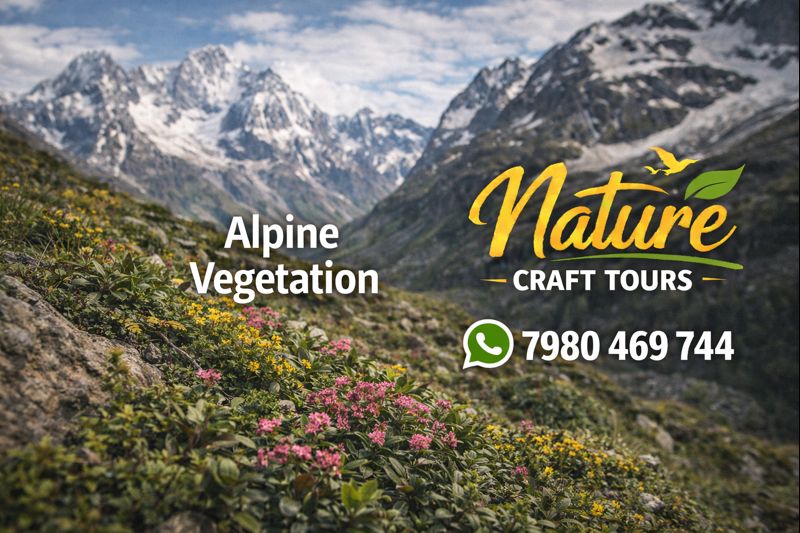

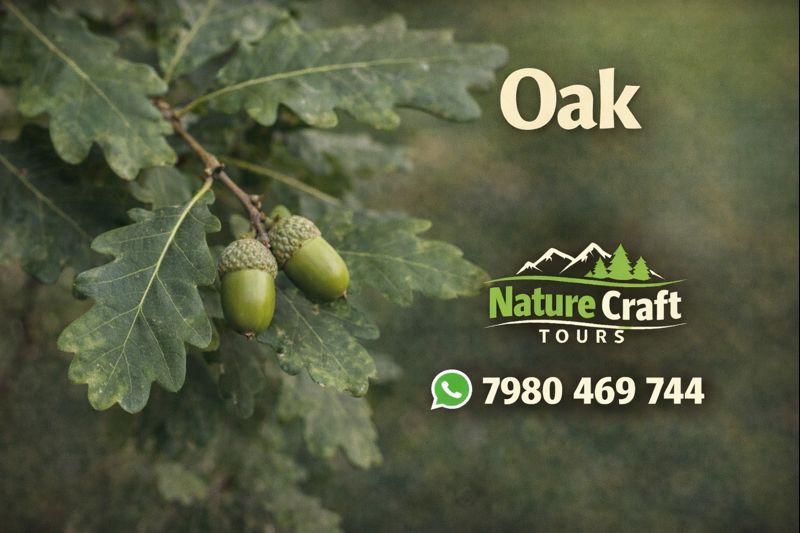
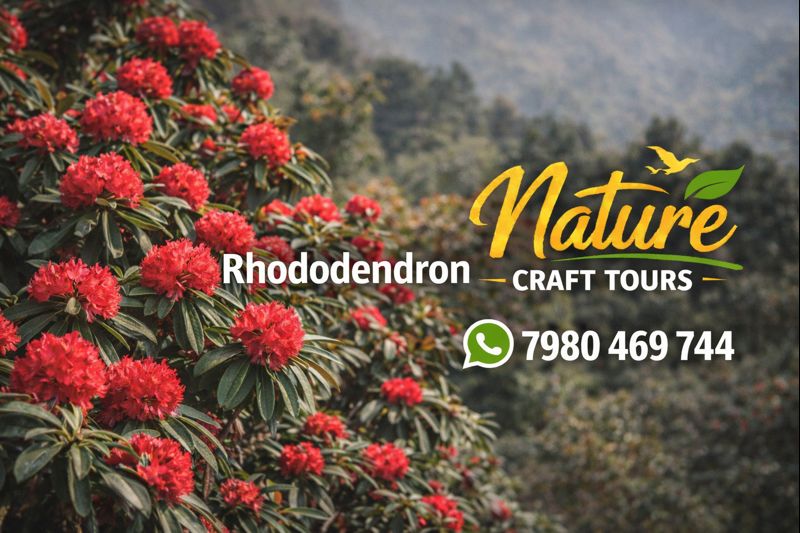
Bamboo is especially important in ecological terms because it is not only a plant component but also a habitat-forming material. It provides cover, feeding opportunity, and movement structure for several animals. Rhododendron adds seasonal color in suitable higher zones and signals a shift toward cooler ecological conditions. Oak belts support a different understorey texture and often influence bird presence through insects, mast, and canopy layering. The park is also known for medicinal and regionally important plant resources, orchids in the wider landscape, and rich undergrowth that reflects both rainfall and relative habitat continuity.
- Tropical evergreen forests in lower humid sectors with dense canopy and broadleaf structure.
- Sub-tropical forests with mixed species composition and varied undergrowth.
- Temperate and upper-elevation vegetation including oak, rhododendron, bamboo, and cooler forest communities.
- High-altitude transitions that move toward alpine character in upper reaches.
For a nature-focused traveler, Mouling’s plant life deserves as much attention as its animals. The forest is not just background scenery. It is the system that makes the park function. The layering of canopy, shrub zone, climbers, leaf litter, and seasonal moisture creates the conditions that sustain insects, amphibians, birds, and mammals. Even without a dramatic animal sighting, walking through a structurally rich Himalayan forest can itself be the main reward.
Fauna
Mouling National Park supports an impressive range of mammals, birds, and smaller life forms associated with the Eastern Himalayan belt. The park is often discussed for charismatic species such as red panda, clouded leopard, Bengal tiger, snow leopard, hoolock gibbon, serow, goral, and capped langur. Yet the ecological importance of the fauna lies not only in rarity but in the diversity of niches represented. Arboreal primates, highland carnivores, slope-adapted ungulates, mid-level forest predators, and canopy birds all point to a habitat mosaic that is still biologically productive.

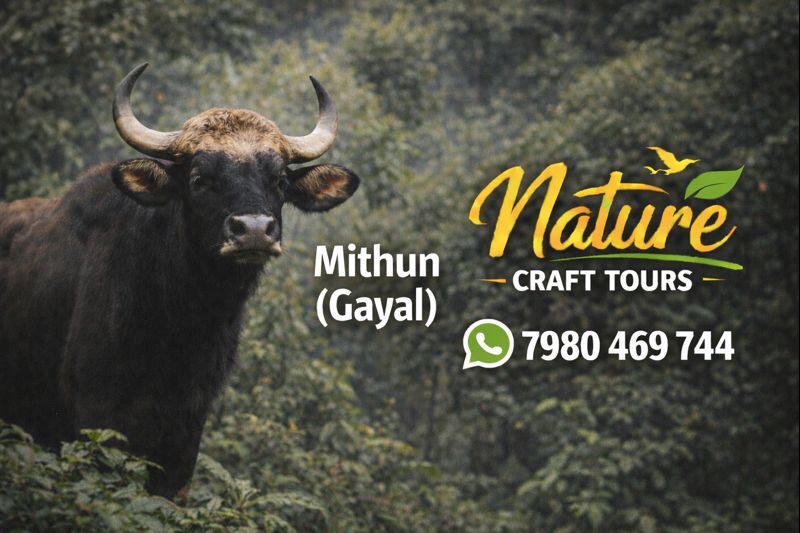





The red panda symbolizes the cooler, bamboo-linked forest character of higher and mid-elevation Himalayan habitat. Its presence indicates healthy, connected, relatively undisturbed forest. Clouded leopard, one of the most elusive cats of Asia, reflects the importance of dense forest cover and vertical movement. Hoolock gibbon, India’s only ape, depends on canopy continuity and is often heard before it is seen. Capped langur and other arboreal species similarly depend on forest structure rather than open ground. Serow and goral represent rougher slopes and rocky or broken terrain, while tiger and leopard indicate a prey base spread across lower and middle forest zones.
Mentions of snow leopard in relation to the larger high-elevation landscape reflect the park’s place within a broader mountain biodiversity zone, though travelers should approach such species lists with realism. Mouling is not a destination where visitors simply arrive and expect a clear line of sightings. The value of the park lies in ecological possibility, field signs, soundscape, and the understanding that intact forest often hides more than it reveals.
- Key mammals: red panda, clouded leopard, Bengal tiger, leopard, serow, goral, capped langur, hoolock gibbon, barking deer, and other forest mammals.
- High conservation value: the park supports species associated with both dense humid forest and upper-elevation mountain habitat.
- Observation reality: more signs, calls, and indirect evidence are common than dramatic open sightings.
Wildlife Experience and Field Observation Value
Mouling National Park is best appreciated by travelers who understand that wilderness does not perform on demand. Forest animals here are alert, adapted to cover, and often active under conditions that reduce direct human visibility. This means the most rewarding visitors are those who slow down. You may not see a predator crossing an open track, but you may hear a primate call moving across a valley, notice fresh hoof marks on damp ground, or watch hornbills tracing a canopy line above a river corridor. Such observations are not lesser experiences. In a park like Mouling, they are the real field experience.
Time of day matters. Early morning usually offers the clearest combination of cooler air, greater bird activity, and lower wind disturbance. Late afternoon can also be good, especially near edges, ridgelines, and stream-associated routes. Weather matters as well. Mist can soften the forest and reduce visibility while improving the atmosphere of the experience. After light rain, sounds may carry more clearly and tracks may become easier to read. During heavy rain, movement becomes more difficult and many practical routes turn slippery or unsafe.
Camouflage plays a major role in wildlife invisibility here. Forest cats blend into light and shadow. Arboreal mammals freeze against canopy branches. Pheasants and ground birds move quietly through the undergrowth. In such an environment, silence is not emptiness. Silence is often the condition in which the forest begins to reveal itself.
Birdwatching Significance

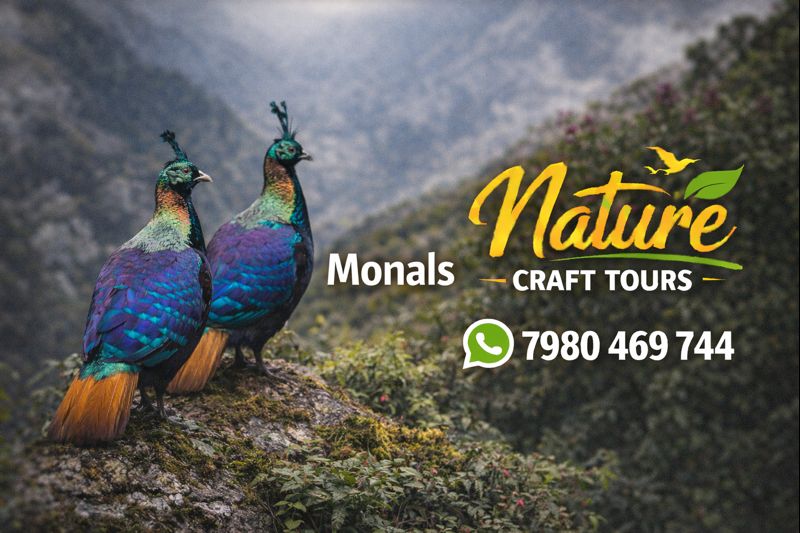

For birdwatchers, Mouling can be deeply rewarding because of its combination of altitude variation, intact forest, and eastern Himalayan biogeography. Hornbills, monals, tragopans, and other forest birds reflect different habitat levels and ecological conditions. Hornbills are especially exciting because they often define the sound and scale of a forested landscape. Their movement over canopy lines gives the observer a strong sense of the park’s vertical structure. Highland pheasants such as monals and tragopans carry a different value, pointing to cooler, more specialized habitat and rewarding those willing to wait in the right belt at the right time.
Winter and post-monsoon periods are often favorable for birding because skies can be clearer, access more stable, and vegetation less overwhelming in certain sectors. Morning bird activity is usually strongest. Good birdwatching in Mouling is not simply about checking species off a list. It is about learning how sound, altitude, forest edge, fruiting trees, and stream corridors influence bird presence. Even a small stretch of forest can produce a rich sequence of calls if one remains still.
Main Attractions
Trekking Routes and Forest Walks
Mouling is fundamentally a park to be experienced on foot in selected accessible sectors with local guidance. Trekking here is not only a physical activity but also the main way to understand the landscape. Trails move through forest gradients, bamboo belts, humid valleys, and ridgeline viewpoints. Because terrain and weather strongly affect conditions, trekkers should expect variation rather than a standardized route system.
Siang and Siyom-linked River Landscapes
The broader river setting around Mouling gives the region a dramatic geographical identity. Major and minor rivers influence settlement patterns, access logic, humidity, and habitat flow. Even when the park core is forest-dominant, the river presence shapes the sense of scale. Travelers often remember the region not only for dense greenery, but for the meeting of mountain forest and powerful water systems.
Mouling Peak and High View Landscapes
Mouling Peak gives the park its identity and represents the upper mountain character of the protected area. Even when not every traveler attempts a demanding approach, the idea of the peak frames the park as an elevational wilderness. Local cultural respect for the peak adds meaning to the physical landscape.
Wildlife and Forest Silence
A major attraction of Mouling is the atmosphere of genuine remoteness. Visitors come here not for guaranteed spectacle, but for forest continuity, canopy sounds, bird movement, and the possibility of encountering signs of rare wildlife. In practical terms, the silence itself is one of the park’s defining attractions.
Field Photography and Ecological Observation
Photographers interested in landscapes, mist, rivers, forest texture, orchids, mossy trunks, and mountain light can find Mouling highly rewarding. Because direct megafauna sightings are not guaranteed, this is a destination where ecological photography often becomes more meaningful than trophy wildlife imagery.
Tribal, Cultural, and Human Landscape Context
The landscape around Mouling is closely associated with Adi communities and the cultural geography of the Siang region. Forests, rivers, slopes, and peaks are not merely resources or scenic backgrounds in this context. They are part of lived environmental knowledge. This is why respectful travel matters here. Visitors should treat the region as a cultural landscape as well as a protected wilderness. Local guidance is valuable not only for navigation but also for understanding weather behavior, route safety, seasonal conditions, and the meaning of particular places.
In remote northeastern landscapes, conservation often works best where local people, customary understanding, and formal protection remain in dialogue. Travelers benefit from approaching this region with humility. Ask before photographing people, avoid intrusive behavior in villages, and do not treat indigenous culture as display material. A more respectful approach usually leads to a better experience and deeper understanding.
Best Time to Visit
The most suitable period for visiting Mouling National Park is generally from November to April. This is the part of the year when access conditions are relatively better, rainfall pressure is lower than the monsoon months, and forest travel becomes more manageable. Winter and early spring often provide the best combination of pleasant daytime conditions, clearer skies, and improved field movement in many sectors.
November to February is especially attractive for travelers who prefer cool air, stable visibility, and stronger birdwatching conditions. Forest mornings can be crisp, especially at higher elevations, so warm layers are essential. March and April offer a different mood. The landscape remains beautiful, flowering vegetation may become more noticeable in some belts, and temperatures begin to rise in lower zones, though conditions are usually still manageable for travel.
The monsoon season, roughly from June to September, is usually the least practical period for a visit. Heavy rain can make trails muddy, slopes unstable, river crossings risky, and road access uncertain. In a mountain forest park, monsoon does not simply mean getting wet. It can alter the entire safety and logistics equation. Even the pre-monsoon period may bring sudden showers, so waterproof planning remains wise.
- November to February: best for cool weather, birding, and clearer travel conditions.
- March to April: good for trekking and broader landscape viewing, though lower areas may feel warmer.
- June to September: usually avoid because of heavy rainfall, slippery routes, and logistical uncertainty.
Timings, Entry Rules, Permits, and Visitor Regulations
The park is commonly visited during daylight hours, and the original visitor information associated with this guide notes opening hours from 7:00 AM to 5:00 PM. In remote protected areas like Mouling, however, visitors should treat timings as functional guidance rather than urban-style fixed service hours. Seasonal conditions, road status, local instruction, and ranger advice can affect the day’s movement plan.
- General visiting hours: 7:00 AM to 5:00 PM
- Open days: usually all days of the week, subject to weather and local administrative conditions
- Recommended practice: begin early and exit active forest zones before late evening
- Guide support: strongly recommended, and in some areas effectively essential
- Protected area discipline: no littering, no loud music, no feeding animals, and no off-route wandering without approval
Because the park lies in Arunachal Pradesh, travelers should also account for state-level entry requirements. Indian visitors generally need an Inner Line Permit for Arunachal Pradesh unless exempt under applicable rules, while foreign travelers should verify the current protected-area and state entry formalities before travel. Always carry government-issued identification, permit printouts or digital copies, and a few photocopies for checkpoints where needed.
Protected-area rules are not formalities without purpose. In a park like Mouling, route discipline, noise control, and local guidance help reduce disturbance to wildlife while also protecting visitors from avoidable risks in a rugged and often poorly connected landscape.
Ticket Fees and Booking Process
The fee details provided in the original park information are useful for planning, though travelers should recheck current charges before departure because forest department fees can change. Camera policies may also be updated depending on equipment type and local regulations.
- Indian Nationals: ₹100 per person
- Foreign Nationals: ₹300 per person
- Children below 12 years: ₹50 per person
- Still Camera Fee: ₹200
- Video Camera Fee: ₹500
The booking process is usually practical rather than elaborate. In remote parks, success often depends less on a sleek online system and more on proper pre-contact, permit readiness, and local coordination.
- Confirm permits first. Verify Arunachal entry requirements and protected-area access needs before fixing transport.
- Check park-entry procedure. Ask whether booking must be done through a forest office, local authority, or approved operator.
- Carry identity documents. Aadhaar or other valid ID for Indian travelers; passport and visa-related papers for foreign travelers.
- Arrange guide and vehicle in advance. This is often more important than the ticket itself.
- Keep buffer time. Remote travel in Arunachal Pradesh can take longer than map estimates suggest.
How to Reach
By Air
Travelers commonly approach the broader region via Assam. Dibrugarh has long been one of the practical air gateways for reaching the Siang side of Arunachal Pradesh, while Pasighat also serves as an important aviation access point in the region. The key point is that air travel only brings you to the threshold. The final journey still depends on road coordination, weather, and local vehicle availability.
- Dibrugarh Airport: useful for those entering through Assam and continuing by road.
- Pasighat Airport / regional air access: useful depending on current connectivity and schedules.
By Rail
Rail travelers often use Murkongselek as a practical station for reaching the Pasighat side of the region. From there, onward travel must be arranged by road. As with many northeastern destinations, the rail station is only one step in a layered journey.
- Nearest useful railway link: Murkongselek
- Next step: hired taxi, shared vehicle, or pre-arranged transfer toward Pasighat, Yingkiong, Jengging, or the relevant access point
By Road
Road travel is the decisive part of reaching Mouling. Major route logic usually involves moving through Pasighat or Aalo and then onward toward Upper Siang access points such as Yingkiong, Jengging, or villages connected to the park fringe. Some official descriptions note that approach to the park core itself is difficult and not possible through straightforward road access in all sectors. That is why local route planning is essential.
- Use a sturdy vehicle: preferably one suitable for hilly roads and variable surface conditions.
- Start early: mountain roads and remote transfers take time.
- Avoid late-night arrivals: reach your transit town before dark where possible.
- Keep fuel and food planning in mind: do not assume frequent service points.
Accommodation and Stay Planning
Mouling is not a destination where visitors should assume a wide choice of polished resort infrastructure at the park edge. Stay planning usually works best by dividing the journey into regional stops. Travelers may stay in towns such as Pasighat, Aalo, Yingkiong, or other transit points depending on route choice, then move onward with local coordination. In some cases, simple forest-side or community-linked accommodation may be part of the travel plan, but comfort levels can vary greatly.
- Town hotels and guesthouses: best for those wanting more dependable food, charging points, and basic comfort.
- Government or local lodges: may be useful in selected areas, but confirm availability in advance.
- Remote stay options: may be simple, with limited hot water, patchy network, and early meal timings.
- Advance booking: strongly advisable during active travel months.
Travelers should set realistic expectations. In remote ecological destinations, the quality of experience often comes from location and access rather than luxury. A clean room, dependable meals, warm layers, and a good local coordinator may matter far more than decorative amenities.
What Travelers Should Know Before Going
This is the most important practical section for Mouling National Park because the destination is beautiful but logistically serious. Preparation shapes the quality of the visit.
- Carry permits and ID proof carefully. Keep printed and digital copies.
- Do not depend fully on mobile network. Connectivity can be weak or absent.
- Carry enough cash. ATMs may be limited or far away.
- Wear proper footwear. Good grip is essential on wet, sloping, and uneven ground.
- Pack layers. Lower valleys and higher points can feel very different in temperature.
- Rain protection matters. Even outside peak monsoon, sudden showers are possible.
- Carry a basic medical kit. Include personal medicines, antiseptic, bandages, and stomach remedies.
- Plan drinking water and simple snacks. Do not assume convenient supply points on the route.
- Use local guidance. This improves both safety and ecological understanding.
- Be realistic about families and seniors. This is better suited to nature-oriented travelers comfortable with remoteness rather than those seeking effortless access.
- Children can travel if the family plans carefully, but difficult terrain means routes should be selected conservatively.
- Solo travelers should coordinate transport well. Remote arrival without local contact is not advisable.
- Respect wildlife distance. No chasing, loud calling, or flash-heavy disturbance.
- Leave no waste. Carry back all disposable items.
Another important point is mental preparation. Mouling is not a destination for those who become frustrated when travel feels slow. Weather may change, roads may take longer than expected, and sightings may remain subtle. The traveler who arrives with patience usually leaves with the most meaningful experience.
Interesting Facts
The biodiversity of Mouling National Park becomes easier to appreciate when its wildlife is placed in the larger context of Indian protected areas. The park combines humid forest mammals, arboreal primates, mountain ungulates, pheasants, and large carnivores in a single Eastern Himalayan setting. The table below highlights some of the better-known species associated with Mouling and shows other Indian national parks where these animals are also found or regionally represented.
| Wildlife Species | National Parks in India |
|---|---|
| Red Panda | Mouling, Namdapha, Singalila, Khangchendzonga |
| Clouded Leopard | Mouling, Namdapha, Manas, Buxa |
| Bengal Tiger | Mouling, Namdapha, Manas, Kaziranga, Jim Corbett, Ranthambore, Sundarban |
| Leopard | Mouling, Rajaji, Corbett, Satpura, Bandipur, Sanjay Gandhi |
| Hoolock Gibbon | Mouling, Namdapha, Manas |
| Capped Langur | Mouling, Manas, Raimona |
| Serow | Mouling, Namdapha, Khangchendzonga, Great Himalayan National Park |
| Goral | Mouling, Great Himalayan National Park, Rajaji, Khangchendzonga |
| Monal | Mouling landscape, Great Himalayan National Park, Kedarnath, Gangotri |
| Tragopan | Mouling landscape, Namdapha, Khangchendzonga, Great Himalayan National Park |
| Hornbills | Mouling, Namdapha, Manas, Kaziranga, Pakke landscape |
Important Facts
Mouling National Park matters because it preserves an intact slice of the Eastern Himalayan ecological gradient. Many protected areas are discussed through a few flagship species, but Mouling deserves attention for its structural importance. It contains humid forest, elevational change, river influence, low human pressure in core areas, and strong habitat continuity. These features make it valuable for both conservation and scientific interest.
- Second national park of Arunachal Pradesh: established after Namdapha, marking an early conservation milestone in the state.
- Part of a larger biosphere setting: linked to the Dihang-Dibang landscape, which strengthens its ecological significance.
- Strong altitude range: supports different vegetation belts within one protected area.
- Low-visibility but high-value wildlife: the park shelters species that are difficult to observe but ecologically important.
- Remote character: limited connectivity has helped preserve wilderness quality.
- Cultural respect matters: the surrounding region has deep indigenous connections to land and landscape.
Nearby Attractions
Pasighat
Pasighat is one of the most practical gateway towns for travelers entering this part of Arunachal Pradesh. It offers river scenery, access logistics, and a gentler introduction to the Siang region before deeper movement into remote sectors. It is useful for permits, transport arrangement, supplies, and overnight halts.
Yingkiong
Yingkiong serves as an important Upper Siang base and gives travelers a stronger sense of the mountain-river landscape associated with Mouling. It is a good place to understand the region’s scale and prepare for more remote movement.
Aalo (Along)
Aalo has long functioned as an important town in western access planning toward forested regions of Arunachal Pradesh. Depending on your approach route, it may become the practical staging point for onward transport and local coordination.
Mechuka Valley
Though not adjacent in the simple tourist sense, Mechuka is often combined in broader Arunachal itineraries by travelers interested in highland scenery, river valleys, and remote cultural landscapes. It complements Mouling by showing another face of Arunachal Pradesh, more open and visually dramatic compared to Mouling’s dense forest wilderness.
Dibang Valley Region
For serious landscape travelers, the wider Dibang-linked region expands the understanding of northeastern mountain conservation. While itinerary practicality depends on time and road conditions, the broader biosphere context becomes easier to appreciate when Mouling is seen alongside neighboring high-diversity mountain systems.
Tips for Visitors
- Plan conservatively and keep buffer time for weather, road conditions, and permit checks.
- Dress in layers and choose neutral outdoor colors rather than bright clothing.
- Carry binoculars, a flashlight, waterproof covers, and a power bank.
- Do not expect instant wildlife sightings; value tracks, calls, and habitat reading.
- Use local guides not only for route safety but also for ecological interpretation.
- Stay quiet in forested areas; noise reduces both wildlife possibility and the quality of the experience.
- Keep waste with you at all times and avoid single-use litter.
- Respect local communities, photography etiquette, and road realities in remote areas.
Sundarban Connection and Ecological Comparison
At first glance, Mouling National Park and Sundarban National Park seem to belong to very different worlds. Mouling is a mountain forest protected area in Arunachal Pradesh, shaped by steep slopes, river-cut valleys, layered altitude, and the cool-to-humid transitions of the Eastern Himalaya. Sundarban, by contrast, is a tidal mangrove landscape of estuarine channels, mudbanks, creeks, saline influence, and amphibious ecological rhythm. Yet there is a meaningful comparison between the two, especially for travelers who are trying to understand how different Indian national parks create different forms of wilderness experience rather than simply different species lists.
Both landscapes demand patience. In Mouling, thick canopy, folded terrain, and variable light hide animals in mountain forest. In Sundarban, tides, reed edges, mangrove density, creek geometry, and mudflats conceal life in another way. In both places, wildlife often appears through signs before direct views. Deer alertness, bird alarm calls, silence before movement, and the cautious use of habitat by predators are all part of the reading of the landscape. A traveler used to open grassland safari may initially find both parks demanding, but that difficulty is exactly what gives them depth.
Another similarity lies in ecological sensitivity. Mouling’s forests are fragile because mountain watersheds, slope stability, and habitat continuity are tightly connected. Sundarban’s fragility comes from tidal balance, salinity, erosion, storm exposure, and the delicate relation between land and water. In both cases, disturbance spreads outward through the ecosystem. That is why careful travel matters. Whether one is exploring a Himalayan forest track or studying creek movement in the mangrove delta, responsible behavior is not a moral decoration but a practical ecological necessity.
Predator imagination also connects the two parks. Sundarban is globally associated with the Bengal tiger, but the actual experience of tiger country there is often one of tension, caution, and indirect presence rather than constant visual encounter. Mouling has its own predator mystery through tiger, leopard, and clouded leopard habitat, where concealment is equally central. In both places, prey species survive through alert movement, edge awareness, and careful use of cover. This makes observation psychologically rich. The visitor begins to sense the forest or wetland as a field of signals rather than a postcard view.
Birdlife offers another bridge. The species are different, but both parks are valuable for birdwatching because habitat variety creates distinct observation opportunities. In Sundarban, channels, mudflats, mangrove edges, and intertidal spaces support waders, kingfishers, raptors, and wetland-associated birds. In Mouling, altitude and forest structure support hornbills, pheasants, canopy birds, and montane specialists. A traveler interested in Sundarban tour landscapes may therefore appreciate Mouling not because the scenery is similar, but because both destinations teach the same lesson: wildlife-rich places reveal themselves slowly.
There is also a travel-experience comparison worth noting. Sundarban is usually read from a boat, through water routes, tide timing, and lookout points. Mouling is read through foothill roads, trail access, ridge movement, and forest sound. One is horizontal and tidal; the other is vertical and mountainous. Yet in both landscapes, weather, silence, and timing deeply influence what the traveler receives. For readers familiar with Sundarban tour package planning or those who have explored a Sundarban private tour, Mouling offers a useful contrast: it replaces tidal navigation with mountain forest immersion, but preserves the same sense that nature remains in command.
Mouling National Park is not a park that reveals everything quickly, and that is exactly why it deserves attention. It represents a form of wilderness that is becoming rare: difficult, layered, biologically rich, culturally rooted, and still governed more by forest rhythm than by tourism pace. For travelers who value ecological depth, mountain silence, bird calls, hidden wildlife, river-linked landscapes, and the feeling of entering a serious protected area, Mouling offers something memorable and genuinely different. It is a place where the forest is not a backdrop to the trip. The forest is the trip.