Updated: 17 April 2026
Namdapha National Park: A Comprehensive Guide
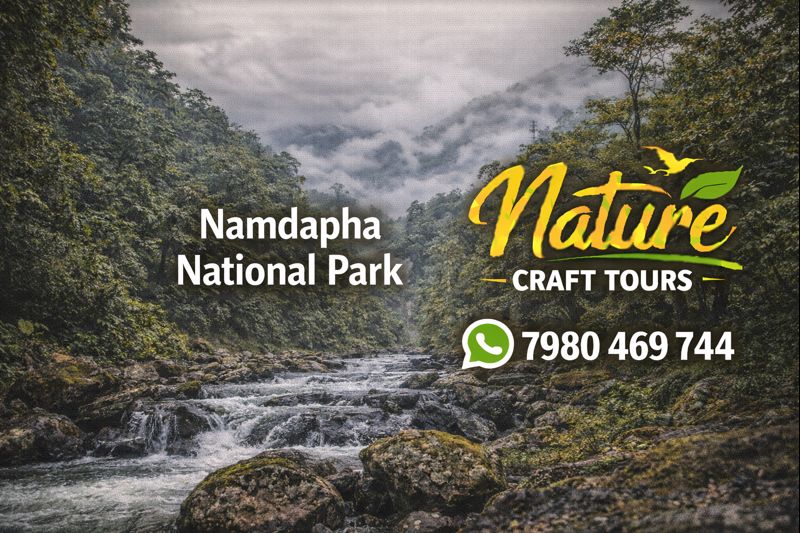
Namdapha National Park, located in the remote Changlang district of Arunachal Pradesh, stands as one of India’s most ecologically complex and least disturbed wilderness landscapes. Covering an expansive 1,985 square kilometers, it is not only the largest protected area in the state but also among the most biodiverse national parks in Asia. Its geographical position at the intersection of multiple biogeographic zones makes it a living laboratory of ecological transitions, where tropical rainforests gradually rise into temperate woodlands and alpine meadows.
Unlike many popular national parks that are structured around tourism circuits, Namdapha offers a raw, immersive experience. Here, the forest does not perform for visitors; rather, visitors must adapt to the forest’s rhythm—slow, silent, and deeply observant. This guide explores every dimension of the park, from its ecological depth to visitor logistics, while maintaining a clear focus on its natural identity.
History and Overview
Established in 1983 and later designated as a Tiger Reserve under Project Tiger, Namdapha National Park derives its name from the Namdapha River that flows through its terrain. The park’s altitudinal range—from 200 meters to over 4,500 meters—is one of its most defining features. This dramatic elevation gradient creates a vertical ecological spectrum rarely seen within a single protected area.
The park lies within the convergence of three major biodiversity hotspots: the Eastern Himalayas, Indo-Burma, and Sundaland. This convergence is not just a geographical coincidence but an ecological phenomenon that allows species from different evolutionary lineages to coexist. As a result, Namdapha is not simply a forest—it is a layered ecosystem where climatic variation, soil types, and hydrological patterns interact continuously.
The terrain includes dense valleys, steep ridges, river floodplains, and high-altitude snow-covered zones. The Noa-Dihing River, one of the last free-flowing rivers in Northeast India, acts as a central hydrological artery, shaping the park’s ecological dynamics through seasonal flooding and sediment deposition.
Flora and Fauna
Flora






The vegetation of Namdapha evolves dramatically with elevation. At lower altitudes, dense tropical evergreen forests dominate, characterized by towering Dipterocarp trees that create a multi-layered canopy. Beneath this canopy, bamboo thickets, shrubs, and ground vegetation form a complex undergrowth that supports diverse insect and amphibian life.
As elevation increases, the forest transitions into subtropical and temperate zones, where oaks, magnolias, and rhododendrons appear. In higher reaches, alpine meadows replace forests entirely, marked by grasses and hardy shrubs adapted to extreme climatic conditions.
The park is particularly rich in epiphytic plants such as orchids and mosses, which thrive in the humid environment. These plants are not merely decorative—they play a crucial role in maintaining moisture balance and supporting micro-ecosystems within the forest.
Fauna












Namdapha’s wildlife is remarkable for both diversity and rarity. It is the only protected area in the world known to host four large feline species: the Bengal Tiger, Indian Leopard, Clouded Leopard, and Snow Leopard. This coexistence reflects the park’s varied altitude and habitat structure, allowing different predators to occupy distinct ecological niches.
Primates such as Hoolock Gibbons and Assamese Macaques are commonly observed in the canopy, while elusive species like the Red Panda inhabit higher altitudes. The park also supports a rich avian population, with over 400 bird species including hornbills, eagles, and migratory birds.
The predator-prey relationship is subtle yet powerful here. Ungulates such as deer move cautiously through forest clearings, constantly alert to predator presence. This silent tension defines the ecosystem’s balance and contributes to the park’s unique atmosphere.
Main Attractions
Biodiversity
The extraordinary biodiversity of Namdapha is not limited to species count; it extends to ecological processes. The forest operates as a self-regulating system where decomposition, regeneration, and predation occur simultaneously.
Hiking and Trekking
Trekking routes such as Deban to Vijaynagar offer immersive journeys through changing habitats. These trails are not merely physical paths but ecological corridors where visitors can observe transitions in vegetation, temperature, and wildlife behavior.
Birdwatching
Birdwatching in Namdapha is a sensory experience. The forest’s soundscape—calls, wingbeats, and distant echoes—guides observers more than visual cues. Seasonal migrations further enhance this experience.
Tribal Culture
The Lisu, Chakma, and Tangsa communities maintain a deep relationship with the forest. Their traditional knowledge reflects sustainable coexistence, offering insights into resource use without ecological degradation.
Sundarban Connection and Ecological Comparison
While geographically distant, Namdapha National Park and the Sundarban delta ecosystem share deeper ecological connections that become evident through careful observation. The Sundarbans, known globally for its tidal mangrove forests, represent a lowland wetland ecosystem, whereas Namdapha rises into mountainous terrain. Yet, both landscapes operate under a common principle—dynamic interaction between water, vegetation, and wildlife.
In the Sundarbans, the constant movement of tidal rivers shapes the forest, creating mudflats, creeks, and islands. Similarly, Namdapha’s river systems, particularly the Noa-Dihing, carve valleys and sustain floodplain forests. These hydrological patterns influence animal movement, feeding behavior, and habitat selection in both regions.
The presence of apex predators is another significant similarity. The Sundarbans are home to the Royal Bengal Tiger, while Namdapha supports multiple big cat species. In both ecosystems, predator behavior is shaped by terrain—dense mangroves in one case and layered forests in the other. This results in highly adaptive hunting strategies and heightened alertness among prey species.
Birdlife diversity is equally striking. Migratory birds use both ecosystems as seasonal habitats, taking advantage of abundant food resources and relatively undisturbed environments. Observing bird behavior in either region reveals patterns of movement, feeding, and nesting that are closely tied to seasonal changes.
From a visitor’s perspective, both destinations offer a similar psychological experience—silence punctuated by sudden movement. Whether drifting through creeks on a Sundarban tour package or trekking through Namdapha’s forest trails, one becomes acutely aware of subtle environmental cues: rustling leaves, distant calls, or shifting shadows.
The fragility of these ecosystems also connects them. Both are highly sensitive to climate change, human intrusion, and habitat fragmentation. Conservation efforts in each region emphasize minimal disturbance and sustainable tourism practices.
For travelers seeking a deeper understanding of India’s natural diversity, combining Namdapha with a carefully planned Sundarban travel experience or exploring a guided Sundarban tour can provide a comprehensive perspective on how different ecosystems function under shared ecological principles.
Timings and Days of Operation
Opening Hours: 6:00 AM to 5:00 PM, open throughout the week. Seasonal conditions, especially during monsoon, may affect accessibility.
Ticket Fees
Indian Nationals: ₹100 per person
Foreign Nationals: ₹500 per person
Children (below 12 years): Free
Camera Fee: ₹75 (still), ₹500 (video)
Booking Procedure
Visitors must obtain necessary permits, especially the Inner Line Permit for foreign nationals. Tickets are available online or at the entry gate. Hiring a local guide is essential for safety and ecological understanding. Accommodation options include forest lodges and designated campsites.
How to Reach
By Air: Dibrugarh Airport (182 km)
By Rail: Tinsukia Railway Station (140 km)
By Road: Accessible via Miao, with jeep and taxi services available.
Best Time to Visit
The period from October to April offers the most stable weather and optimal wildlife visibility. Seasonal transitions during this time reveal varied ecological patterns.
Nearby Attractions
Miao, Deban Campsite, Lake of No Return, and Raja Rani Hill provide additional cultural and scenic experiences that complement the park visit.
Important Facts
Namdapha’s ecological uniqueness lies in its vertical habitat diversity, coexistence of multiple apex predators, and presence of indigenous communities practicing sustainable living.
Tips for Visitors
Carry essential gear, respect ecological sensitivity, rely on local guides, and plan logistics carefully due to remote access and limited connectivity.
Namdapha National Park remains one of India’s most profound wilderness experiences. It is not defined by quick sightings but by slow understanding—of forests, rivers, and the silent language of nature.