Madhya Pradesh (11 National Parks):
A Guide to Central India’s Finest Protected Landscapes
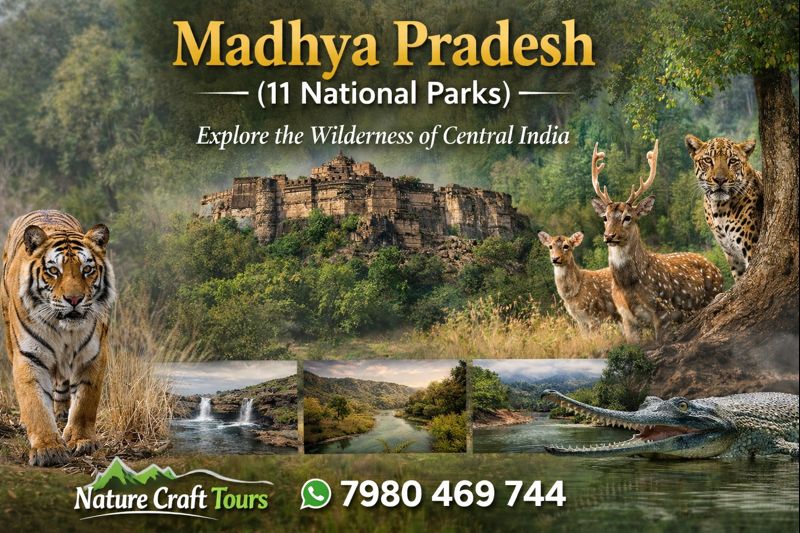
Madhya Pradesh is widely regarded as the ecological heart of India. This reputation is not a slogan; it is a measurable reality rooted in geography, forest cover, river basins, and the continuity of central Indian wilderness. Positioned between the Indo-Gangetic plains and the Deccan plateau, the state contains extensive belts of tropical deciduous forests, bamboo brakes, open grasslands, rocky escarpments, and riverine corridors. These habitats collectively sustain complex food webs—ranging from microscopic aquatic organisms and pollinating insects to apex predators such as tigers and leopards.
The state’s protected-area network is among the most influential in the country’s conservation architecture. Within Madhya Pradesh, 11 national parks preserve representative ecosystems, safeguard rare and endangered species, and protect paleontological assets that record life on Earth across deep time. Some parks are globally recognized tiger landscapes; others are priceless fossil repositories, documenting ancient forests and dinosaurs that existed long before the modern subcontinent took shape. Together, these eleven parks form a diverse portfolio of natural heritage, supporting conservation science, environmental education, responsible tourism, and community-based livelihoods.
This article is a detailed, formal, and descriptive overview of the 11 national parks of Madhya Pradesh: Bandhavgarh National Park, Dinosaur Fossil National Park, Ghughua Fossil National Park, Kanha National Park, Kuno National Park, Madhav National Park, Panna National Park, Pench National Park, Sanjay National Park, Satpura National Park, and Van Vihar National Park. The goal is not merely to list names, but to explain why each landscape matters—ecologically, scientifically, and culturally—and how a thoughtful visitor can experience these places responsibly.
Why Madhya Pradesh Matters for Indian Wildlife Conservation
The biodiversity of Madhya Pradesh is shaped by central Indian biogeography. The dominant vegetation type in many regions is tropical deciduous forest (sal and teak formations, among others), which supports both grazing and browsing herbivores such as chital, sambar, nilgai, and wild boar. These herbivores form the prey base for predators such as tigers, leopards, dholes (where present), and smaller carnivores including jungle cats and civets. The state’s river systems and wetlands enrich this terrestrial complexity, providing breeding grounds for amphibians, supporting fish diversity, and sustaining birds—particularly during seasonal migrations.
Equally important is the role of connectivity. Wildlife populations cannot remain healthy if protected areas function as isolated islands. Across Madhya Pradesh, several parks and surrounding forest divisions work as stepping-stones and corridors. This movement supports genetic exchange, reduces local inbreeding risks, and increases the probability that species can adapt to changing environmental conditions. In conservation planning, such connectivity is not a luxury; it is a requirement for long-term resilience.
Understanding the “National Park” Category in Practical Terms
A national park is a legally protected area established for conserving wildlife and habitats with strict controls on resource extraction and land-use change. In practical terms, this means the primary purpose of a national park is ecological integrity: preserving natural processes, protecting breeding grounds, maintaining vegetation communities, and minimizing disturbance to wildlife. While tourism is permitted in many parks, it is typically regulated through entry rules, timing restrictions, designated routes, and capacity management to reduce ecological stress.
In Madhya Pradesh, several national parks also serve as core areas of larger conservation units (such as tiger reserves or landscape-level management zones). The outcome is a layered system in which national parks are the strictest conservation cores, supported by buffer areas that enable compatible human activities while reducing pressure on sensitive habitats.
A Carefully Curated Way to Experience Multiple Parks
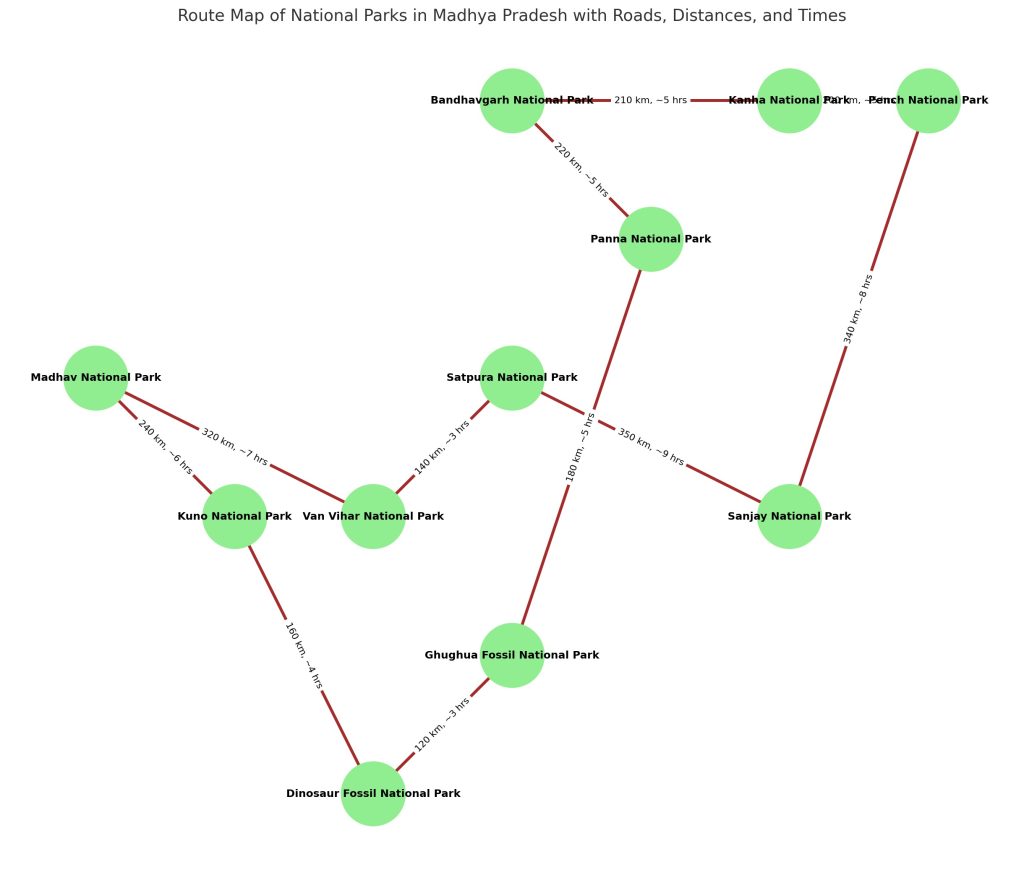
For a traveler or researcher, Madhya Pradesh offers more than isolated visits. The state can be approached as a biodiversity circuit: a sequence of landscapes that reveals how forests, grasslands, rivers, and geological history interact across central India. A well-designed route can combine (1) a flagship tiger landscape (such as Kanha, Bandhavgarh, Pench, Panna, or Satpura), (2) a conservation-restoration narrative (such as Kuno or Panna), and (3) a scientific heritage site (such as Ghughua or Dinosaur Fossil National Park). This “three-dimensional” approach—wildlife, restoration, and deep time—creates a richer understanding than a single park visit can provide.
Bandhavgarh National Park
A Compact Landscape with Powerful Predator Ecology
Bandhavgarh National Park is one of India’s most discussed tiger landscapes, often associated with strong visibility and high predator presence. Its ecological character is shaped by a mosaic of sal forests, mixed deciduous patches, grasslands, and rocky ridges. Such a mosaic is significant because it creates multiple microhabitats: shaded forest cover for resting, open meadows for grazing prey, and edge zones where predator–prey interactions intensify. In central Indian forests, edges—where grass meets tree cover—are critical hunting arenas for ambush predators.
Bandhavgarh is also distinguished by a striking cultural layer. The terrain is crowned by an ancient fort complex and associated caves and historical structures. This overlap of heritage and wildlife is more than scenic; it affects land-use history, trail networks, and the spatial distribution of human presence over centuries. A visitor’s best experience of Bandhavgarh comes from observing how animal behavior responds to landscape structure: the way prey species cluster near water in dry months, the way alarm calls travel through forest edges, and the way predator movement often follows cover lines and natural contours.
Dinosaur Fossil National Park
Where Biodiversity Meets Deep-Time Science
Dinosaur Fossil National Park represents a different dimension of “nature.” While most national parks are defined by living ecosystems, this park is defined by geological memory. Fossilized dinosaur eggs and remains found in the region help reconstruct prehistoric environments that existed long before present-day forests emerged. Such sites are essential because they connect conservation and education to Earth science, making nature interpretation far more expansive than wildlife sightings alone.
For students and researchers, fossil parks function as field classrooms. The scientific value lies in stratigraphy, sediment context, and the broader geological setting that preserves fossils. For visitors, the experience is intellectually enriching when approached with patience: noticing rock textures, understanding why certain layers preserve organic traces, and realizing that “protected areas” can safeguard not only living species but also non-renewable scientific resources. In a country where public understanding of paleontology is still emerging, Dinosaur Fossil National Park plays an important role in building scientific literacy.
Ghughua Fossil National Park
Petrified Forests and the Story of Ancient Flora
Ghughua Fossil National Park (also known for its plant fossil heritage) preserves extensive petrified wood and fossil plant remains, offering rare insight into prehistoric vegetation. Fossilized tree trunks—transformed over time into stone—carry information about ancient climates and plant communities. In paleobotany, such fossils help scientists infer rainfall patterns, temperature regimes, and the evolutionary pathways that shaped today’s forests.
From a visitor’s perspective, Ghughua is best understood as a museum without walls. The “exhibits” are natural: fossil trunks embedded in rock, remnants of ancient forests that existed under climatic conditions different from the modern era. This park supports conservation through education. When people understand that nature has deep history—and that geological records can be lost through unregulated collection or destruction—they are more likely to support protective laws and scientific stewardship.
Kanha National Park
A Benchmark Landscape for Habitat Management
Kanha National Park is often cited as a benchmark for central Indian wildlife management because its habitats are structured in a way that supports both biodiversity and effective protection. The park’s expansive meadows, sal forests, and bamboo thickets create high-quality conditions for herbivores and, therefore, for predators. This structure is not accidental: meadow maintenance, controlled burning in certain contexts, invasive management, and water provisioning (where ecologically justified) can influence prey distribution and overall ecosystem health.
Kanha is also widely associated with the conservation narrative of the barasingha (hard-ground swamp deer). The recovery of such a species illustrates a core principle of conservation biology: protecting a flagship species often protects a wider habitat network, benefiting many other organisms. For visitors, Kanha’s value lies not only in potential tiger sightings but in observing ecological relationships: the way herds use open spaces, the way forest cover provides thermal shelter, and the way seasonal changes reorganize animal movement patterns.
Kuno National Park
Restoration, Landscape Planning, and Future-Facing Conservation
Kuno National Park has become nationally prominent as a landscape identified for ambitious conservation initiatives and species restoration. Ecologically, Kuno is characterized by dry deciduous forests, grasslands, and riverine habitats that together support a prey base and relatively expansive movement space. In restoration-oriented conservation, such “space” matters: large carnivores and wide-ranging species require sufficient territory to establish stable populations without frequent human conflict.
Kuno’s broader significance lies in what it represents: modern conservation increasingly includes rewilding concepts, habitat connectivity, and long-term monitoring. This requires careful governance, local engagement, and sustained funding. For a responsible visitor, Kuno is a place to appreciate the seriousness of conservation planning—how science, policy, and people must align for ecological outcomes to endure. Experiences here tend to be meaningful when focused on landscape understanding rather than a single species checklist.
Madhav National Park
Woodlands, Wetlands, and a Cultural Conservation Context
Madhav National Park offers a blend of forest ecosystems and historical associations. Such parks are valuable because they demonstrate that conservation landscapes often sit within cultural geographies rather than existing separately from them. The presence of water bodies within and near the park enhances its importance for birds, particularly during migratory periods when wetlands become high-priority habitats.
Ecologically, woodland and wetland mosaics support diverse feeding niches: insectivorous birds near reed beds, raptors over open areas, and herbivores in forest edges. For visitors, Madhav National Park provides an opportunity to practice slower wildlife observation—listening for calls, scanning water margins for movement, and appreciating how water availability shapes life in dry seasons. The park can be especially rewarding for travelers who prioritize birding and habitat diversity.
Panna National Park
River Gorges, Mixed Forests, and a Strong Recovery Narrative
Panna National Park is defined by dramatic terrain, including rocky plateaus and river gorges shaped by the Ken River. Such geography matters for biodiversity because it creates habitat variation at short distances—riverine belts, scrub zones, forest patches, and cliff-like formations. These varied microhabitats can support diverse species assemblages, including birds that nest in cliffs, reptiles that use rocky refuges, and mammals that depend on riparian vegetation for cover and water access.
Panna is also notable for its conservation turnaround story, reflecting how targeted interventions and sustained protection can restore wildlife populations. The park illustrates an important lesson: conservation success requires not only ecological suitability but also governance—anti-poaching enforcement, monitoring protocols, and coordination between forest staff and local communities. For visitors, Panna’s value often lies in the landscape itself: the visual drama of gorges and the quiet intensity of riverine forests that support life even in harsh summers.
Pench National Park
Teak Forests, Grasslands, and Corridor Importance
Pench National Park is frequently appreciated for its scenic forest roads, teak-dominated landscapes, and open patches that increase visibility for wildlife observation. Ecologically, teak forests and mixed deciduous zones can support abundant ungulates, particularly where grassland edges and water sources are available. Such prey abundance, in turn, supports large carnivores. The quality of Pench’s habitat mosaic can make it valuable for long-term studies of predator–prey dynamics in central India.
Another critical aspect of Pench is its broader corridor function across the region. In modern conservation, corridors reduce fragmentation and support seasonal and genetic movement. Even when a visitor is focused on a short safari experience, it is worth remembering that the park’s value extends beyond its visible boundaries. The healthiest wildlife outcomes often depend on landscape-level thinking, where protected areas and surrounding forests are managed as connected ecological units.
Sanjay National Park
A Quieter Protected Area with Important Ecological Value
Sanjay National Park is less commercialized than some of the state’s flagship parks, and this relative quietness can be ecologically meaningful. Lower tourism pressure may reduce disturbance in sensitive areas, supporting more natural behavior patterns in wildlife. The park’s forests provide habitat for a range of mammals, including mid-sized carnivores and herbivores, and it supports avian diversity typical of central Indian woodlands.
From a conservation science perspective, quieter parks can function as reference sites for studying natural processes with reduced human impact. For travelers, Sanjay can be rewarding when approached with realistic expectations: the value is not only in iconic sightings but also in experiencing intact forest atmosphere—bird calls at dawn, evidence of animal movement along trails, and the layered textures of deciduous woodland.
Satpura National Park
Rugged Relief, Unique Experiences, and Habitat Diversity
Satpura National Park is distinguished by its rugged terrain—hills, ravines, sandstone formations, and dense forest patches. Such topography often leads to habitat diversity across altitude gradients and slope aspects, creating niches for varied plant communities and wildlife. In ecological terms, complex terrain can also provide refuges that reduce direct human access, which may benefit shy or disturbance-sensitive species.
Satpura is often associated with experiential diversity: opportunities for deeper nature interpretation and, where regulations permit, alternative modes of exploration that emphasize immersion. This approach aligns with a contemporary conservation principle: lower-volume, higher-quality tourism can support local livelihoods while reducing ecological costs. For visitors, Satpura encourages attentive observation—understanding animal tracks, recognizing habitat transitions, and appreciating that wilderness value is often most profound when it is not hurried.
Van Vihar National Park
Urban Conservation, Rehabilitation, and Public Education
Van Vihar National Park, located in Bhopal, represents a distinct conservation model. Unlike remote wilderness parks, Van Vihar operates within an urban setting and contributes strongly to environmental education, awareness-building, and wildlife-related public engagement. In such contexts, conservation is not only about protecting habitat but also about shaping societal attitudes toward wildlife and ecological responsibility.
Urban-proximate protected areas can serve as “first contact” sites where children, students, and families learn to respect wildlife and understand the reasons behind protective laws. Such education is essential for long-term conservation outcomes, because public support influences policy, funding, and compliance. Van Vihar’s value, therefore, extends beyond species display; it is a platform for conservation ethics and learning.
Comparing the 11 Parks: What Makes Each One Distinct
While all eleven parks contribute to conservation, their roles differ. Kanha, Bandhavgarh, Pench, Panna, and Satpura are most closely associated with living wildlife experiences and habitat conservation for large mammals. Kuno represents forward-looking restoration and landscape planning. Sanjay adds value as a quieter forest system with lower tourism intensity. Madhav integrates woodland and wetland dynamics with cultural geography. Van Vihar plays an education and awareness role within an urban environment. Finally, Dinosaur Fossil National Park and Ghughua Fossil National Park preserve deep-time scientific heritage, broadening the definition of protected nature to include non-renewable geological records.
This diversity is precisely why Madhya Pradesh is so important. The state offers not one type of nature, but multiple “kinds” of nature: predator landscapes, river-gorge ecosystems, hill forests, wetlands, and paleontological archives. When treated as a single conservation portfolio, these parks represent a comprehensive environmental asset.
Best Time to Visit and How Seasonality Shapes Wildlife Observation
Seasonality influences visibility, animal movement, and visitor experience across Madhya Pradesh. In many central Indian forests, dry-season conditions can concentrate wildlife around water sources, potentially improving sightings. In contrast, post-monsoon periods often bring lush vegetation, which supports ecological recovery but can reduce visibility due to dense undergrowth. Winter conditions can be comfortable for travel and can also coincide with migratory bird presence in parks with wetlands or nearby water bodies.
However, the “best time” should be understood responsibly. Wildlife observation must never override animal welfare. Ethical tourism values patience, maintains distance, respects silence, and prioritizes habitat integrity over close encounters.
Responsible Tourism Principles for Madhya Pradesh’s National Parks
Ethics That Protect Wildlife and Improve Visitor Quality
Responsible park visitation is a conservation action in itself when practiced correctly. Vehicles must respect speed limits, remain on designated tracks, and avoid crowding animals. Noise pollution—loud conversation, music, or aggressive driving—can disrupt feeding, breeding, and movement. Flash photography should be avoided, especially near sensitive species and at low light. Visitors should remember that parks are not entertainment venues; they are functioning ecosystems where animals bear real physiological costs when disturbed.
Waste management is equally critical. Even small items such as plastic wrappers can harm wildlife. Sustainable tourism also includes respect for local communities: choosing local guides where appropriate, acknowledging cultural contexts, and supporting livelihoods that align with conservation rather than extraction.
The 11 National Parks as a Single Conservation Story
Madhya Pradesh’s eleven national parks form a unified narrative of conservation in central India. They protect living forests where predators and prey sustain natural balance. They safeguard rivers and gorges that support biodiversity through harsh seasons. They preserve fossil records that expand human understanding of ancient life and climates. They educate urban populations and nurture conservation values that shape future policy and behavior.
To visit these parks thoughtfully is to engage with a deeper national responsibility: protecting ecological stability, conserving threatened species, and respecting landscapes that have evolved over millions of years. Whether one’s interest is wildlife photography, ecological research, family learning, or quiet nature immersion, Madhya Pradesh offers a protected-area network of rare breadth and significance—one that deserves informed appreciation and careful stewardship.