Updated : 26 February 2026
Sundarban Tour – Where Dreams Float on Water and Light
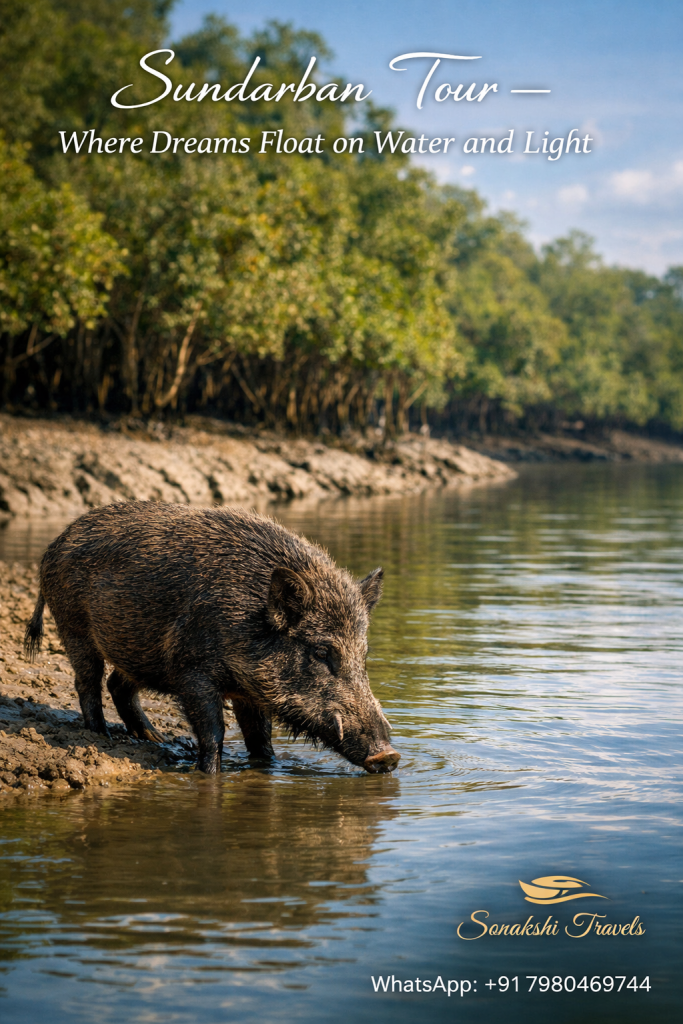
There are landscapes that define themselves through coordinates, and there are landscapes that reveal themselves through experience. The Sundarban belongs firmly to the latter. Within the evolving ecological framework documented by Sundarban Travel, this delta is understood not as static geography but as a living, tidal system where light, sediment, and motion remain in constant negotiation. A Sundarban Tour becomes an immersion into a realm where solidity is provisional and boundaries dissolve into rhythm.
This is not a forest approached by road and measured in linear distance. It is a shifting matrix of channels and mangroves where land appears suspended between emergence and submergence. Rivers mirror the sky so precisely that horizon lines blur. Roots arch above mud like engineered sculptures, holding the delta together through biological precision. To move within this environment is to enter a dialogue between water and light—one shaped by centuries of sediment flow and lunar pull.
Delta as Living Architecture — Fluid Geography and Ecological Design
The Sundarban delta is expansive, yet its defining characteristic is dynamism. Formed from Himalayan silt carried through vast river networks, the terrain evolves through tidal flux and seasonal discharge. The interaction between freshwater and saline intrusion produces a salinity gradient that determines vegetation patterns, wildlife concentration, and even microbial diversity. This delicate balance is the structural foundation of the ecosystem.
Mangrove species such as Heritiera fomes, Avicennia marina, and Sonneratia apetala demonstrate rare physiological adaptations. Pneumatophores rise vertically from submerged soil to access oxygen in anaerobic conditions. Certain species excrete excess salt through specialized glands, maintaining osmotic equilibrium. These are not incidental traits; they are evolutionary responses to a terrain where survival depends on flexibility and structural efficiency.
A carefully designed journey through the mangrove corridors—often interpreted through structured Sundarban forest tour—allows close observation of this architecture of resilience. At low tide, exposed mudflats reveal complex root lattices and sediment textures marked by aquatic movement. At high tide, the same forest appears afloat, as though suspended above a reflective plane. The alternation between exposure and submergence creates visual illusions that challenge perception and deepen engagement.
Light as Structural Element
In the Sundarban, light behaves almost as a tangible medium. The reflective surface of tidal water doubles the sky, intensifying luminosity. Early morning illumination, diffused by moisture in the air, softens outlines into gradual tonal transitions. As the sun ascends, mangrove canopies fracture brightness into narrow shafts that shift with every movement of leaf and tide.
This interplay of reflection and diffusion alters spatial awareness. Forest edges appear closer than they are; distant channels shimmer with metallic sheen. At dusk, silhouettes sharpen against amber horizons, reducing the landscape to elemental geometry—water, branch, sky. The effect is grounded in optical physics and atmospheric composition, yet emotionally it evokes a sense of suspended reality.
The Wild Pulse — Adaptation in a Tidal Realm
The Royal Bengal Tiger embodies the paradox of strength within fluidity. Unlike its counterparts in dry habitats, the Sundarban tiger navigates brackish channels with exceptional swimming capability. Field observations indicate that these tigers routinely traverse creeks, using waterways as movement corridors. Their muscular build and behavioral adaptations reflect long-term adjustment to unstable ground and saline exposure.
In many interpretive wildlife journeys framed within a comprehensive Sundarban tour package program, the emphasis lies not solely on sightings but on ecological context. Fresh pugmarks imprinted on tidal mud, scratch marks etched into bark, or the sudden alarm calls of deer communicate presence with subtle authority. The tiger’s elusiveness reinforces the integrity of the habitat; it exists independent of spectacle.
Beyond the tiger, a network of interdependent species defines the delta’s biological complexity. Estuarine crocodiles remain motionless along creek banks before dissolving into water with minimal disturbance. Fishing cats hunt within marshy margins. River dolphins surface briefly, breaking mirrored symmetry before vanishing beneath tidal currents. Each organism operates within ecological parameters shaped by salinity gradients and tidal timing.
Avian Movement and Aerial Geometry
Birdlife introduces vertical dimension to the horizontal spread of mangrove terrain. Kingfishers flash in vivid arcs above waterlines. Egrets stand motionless in shallow edges before lifting in white formations. Raptors maintain calculated spirals over canopy layers. Ornithological records confirm the presence of more than 260 species, underscoring the delta’s significance as a wetland habitat of international relevance.
At dawn, acoustic layering becomes evident. Territorial calls overlap with feeding signals and migratory notes, forming a complex soundscape structured by ecological hierarchy. Observing these interactions within a thoughtfully paced private Sundarban tour from Kolkata reveals how light intensity, water depth, and nutrient flow shape avian behavior across tidal intervals.
Waterways as Pathways — Movement Without Edges
Movement through the Sundarban is inherently aquatic. Channels curve unpredictably, defined by sediment displacement rather than permanent boundaries. Boats navigate serpentine passages shaped by hydrological forces, where orientation becomes relational rather than directional. The absence of rigid pathways fosters heightened spatial awareness.
Broad rivers such as the Matla and Raimangal present expansive horizons where water and sky converge seamlessly. Narrow creeks create intimacy, their overhanging branches filtering light into shifting patterns. Beneath seemingly calm surfaces, tidal currents maintain continuous motion. Travelling these waterways cultivates awareness of subtle change rather than dramatic shift.
In extended immersive explorations, including multi-day programs such as the 2 Nights 3 Days Sundarban Tour Package, this progression from broad channels to secluded creeks allows travellers to perceive how scale influences experience. Wide rivers evoke expansiveness; narrow waterways heighten attentiveness. Both contribute to the sensation that the forest floats within light.
Tidal Time and Perceptual Shift
Time in the delta is measured less by clocks than by water levels. The rise and fall of tide dictate exposure of mudflats, accessibility of channels, and movement patterns of wildlife. This tidal temporality shapes human perception. Observers often report increased attentiveness, recognizing subtle cues that signal environmental transition.
The rhythm encourages patience. Rather than seeking spectacle, one becomes attuned to incremental transformation—the gradual emergence of sandbanks, the slight darkening of canopy, the nuanced change in water hue as sediment shifts. The dreamlike quality emerges from alignment with these non-linear cycles.
Human Presence — Cultural Continuity Within Flux
Communities residing within the delta navigate a life defined by environmental negotiation. Fishing, honey collection, and small-scale agriculture depend on tidal awareness and inherited ecological knowledge. The narrative of Bonbibi, invoked before forest entry, reflects a worldview grounded in respect for forces beyond human control.
Anthropological studies describe these belief systems as adaptive mechanisms reinforcing communal responsibility and caution. Within broader interpretations of the Sundarban luxury tour experience, encounters with village life illustrate how cultural continuity evolves alongside ecological flux. The relationship between community and mangrove is neither romanticized nor adversarial; it is pragmatic and reverent.
Ethics of Coexistence
Resource extraction follows informal codes that limit overharvest and distribute risk collectively. Seasonal awareness reduces vulnerability in an unpredictable environment. This ethic of coexistence demonstrates how sustainability can emerge organically within constraint.
Travellers who observe these practices gain perspective on the possibility of equilibrium amid instability. The dreamlike perception of the Sundarban thus extends beyond scenery; it reflects a lived model of adaptation within volatility.
Fragility and Endurance — Climate at the Edge
The Sundarban occupies a critical position in global climate discourse. As a vast mangrove forest, it functions as a significant carbon sink, storing organic carbon within biomass and sediment layers. Its root networks dissipate storm surge energy, acting as natural coastal defense. Yet rising sea levels and salinity shifts present measurable challenges.
Scientific monitoring indicates patterns of island erosion and habitat transition. Despite these pressures, mangrove regeneration demonstrates adaptive resilience. Buoyant propagules enable recolonization of suitable substrates, sustaining forest continuity. Conservation initiatives combine research with community engagement to reinforce long-term stability.
Within a structured Sundarban Tour, awareness of this fragility intensifies appreciation. The shimmering water and filtered light carry underlying acknowledgment of vulnerability. Dreams here are not escapist abstractions; they are grounded in ecological interdependence.
Private Passage — Intimacy Within Immensity
Intimate exploration heightens contemplative depth. When movement slows and observation becomes deliberate, subtle phenomena emerge—the texture of bark shaped by saline wind, the faint ripple marking unseen aquatic life, the rustle within foliage signaling hidden presence. Quietude becomes interpretive space.
Naturalists decode spoor, tidal residue, and avian signals into ecological narrative. The experience shifts from surface observation to informed understanding. Dreams float not as illusion but as insight gained through attentive immersion.
When Water, Light, and Perception Converge
The essence of a Sundarban Tour lies in convergence. Water sustains reflection; mangroves anchor shifting sediment; wildlife adapts to oscillation; human culture evolves within environmental flux. Each element reinforces the others in a system defined by equilibrium and transformation.
In this convergence, perception recalibrates. Boundaries soften, reflections multiply, silence acquires depth. What initially appears dreamlike gradually resolves into heightened awareness—an encounter with a landscape that resists simplification.
When travellers depart, they often retain not a single image but a sensory impression: mirrored horizons, luminous channels, forests breathing with tidal cadence. The Sundarban endures through subtlety rather than spectacle. Water and light continue their dialogue beyond the journey, and the dream persists as altered perspective.
To move through this delta is to witness alignment between ecological complexity and experiential depth. Here, dreams do not escape reality; they float upon it—shaped by tide, illuminated by light, and grounded in the living pulse of the mangrove world.