Updated: 26 February 2026
The Crocodile Waits, the Egret Soars—Find Poetry Behind Sundarban Tour Doors
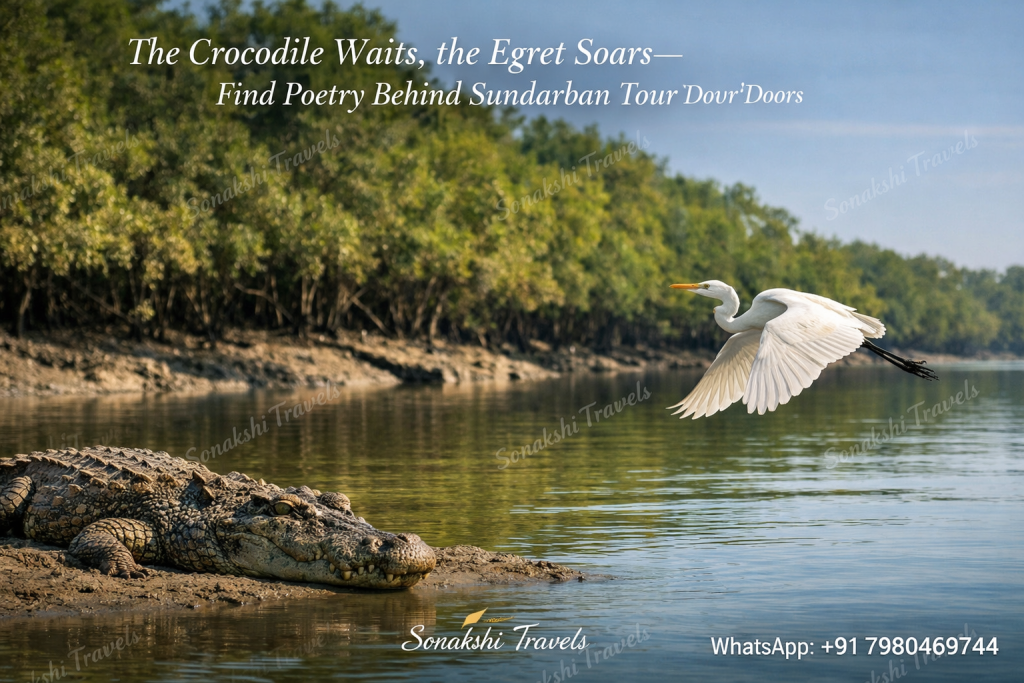
Where Stillness Breathes Stories
There is a particular threshold in the delta where language begins to loosen its authority. It is not marked by gates or architecture. It opens in the hush between two tides, in the pause between a ripple and its echo. Within the wider interpretive context documented across SundarbanTravel.com, this threshold is often described as a Sundarban tour, yet the phrase remains an approximation. What unfolds is less an excursion and more an encounter with rhythm—an encounter that behaves like poetry.
Poetry, in its purest sense, is compression: meaning held tightly within image and silence. The mangrove delta functions in much the same way. The visible is restrained. Movements are minimal. Gestures are deliberate. The crocodile does not dramatize its presence; it occupies space with quiet inevitability. The egret does not declare its flight; it sketches it. Within this economy of motion lies a form of expression that resembles verse more than spectacle.
Behind what might casually be called “Sundarban tour doors” lies a landscape that speaks through timing, restraint, and contrast. It is a place where narrative is not performed loudly but assembled slowly by attention, where meaning emerges through concentration rather than consumption.
The Discipline of Waiting: Crocodile as Living Metaphor
Stillness as Strategy
The saltwater crocodile, often misread as a symbol of simple aggression, embodies a different principle in the delta: patience refined into method. Scientific observation of crocodilian behavior highlights extreme energy conservation, with extended motionlessness supported by metabolic regulation and opportunistic timing. In the Sundarban, this biological efficiency is not merely survival—it becomes a visible philosophy of restraint.
To witness a crocodile here is to observe stillness shaped into strategy. There is no wasted chase, no reckless pursuit. The animal merges with water and mud, reducing itself to texture and tone. Only an eye above the surface signals presence. This is not theatrical suspense; it is ecological intelligence—a reminder that power often becomes most effective when it is least advertised.
Translated into experiential terms, such stillness recalibrates the observer. Human perception, conditioned by rapid stimuli and constant confirmation, begins to slow. The mind adjusts to a pace where meaning is not delivered but located. The crocodile’s wait becomes instruction: poetry does not shout; it accumulates, line by line, through attentive witnessing.
Timing Over Drama
Predation in the delta rarely unfolds as spectacle. It depends on tide cycles, water depth, and subtle environmental cues that determine when concealment becomes advantage. The crocodile’s success lies not in ferocity but in alignment with rhythm. Timing governs action more reliably than force.
This emphasis on timing parallels poetic structure. A line break, a pause, a silence between stanzas—these shape impact more than ornamentation. In the Sundarban, impact is similarly shaped by absence and anticipation. The observer begins to read the water’s surface as one might read punctuation: a faint disturbance becomes a comma; a sudden dive becomes a period. Those drawn to a more interpretive experience often find that this cadence is best encountered within a carefully paced structured Sundarban tour package, where time is allowed to do its quiet work.
Behind the so-called tour door, danger is not loud. It is composed—held back, measured, and revealed only when the rhythm permits.
The Architecture of Flight: Egret as Counterpoint
White Against Green
If the crocodile represents density and depth, the egret offers vertical contrast. Ornithological studies describe egrets as deliberate foragers, yet in the delta they appear almost abstract—white strokes against a saturated green background, clarity moving through complexity. Their presence does not compete with the mangrove; it articulates it by opposition.
Their ascent from mudbank to air is rarely abrupt. Wings unfold in measured arcs. The body rises without haste, carving silence rather than sound. In early light, when mist rests over tidal channels, these birds become shifting calligraphy. They inscribe the sky without residue, leaving only a momentary arrangement of form and direction.
This is not decorative beauty. It is structural counterbalance. Poetry thrives on tension—between weight and lightness, shadow and clarity. The egret provides the necessary lift to the crocodile’s gravity. Together, they construct a living stanza: one anchored, one airborne. For many travelers, it is along the quieter stretches of a river-led delta exploration that this contrast becomes most legible, because the eye is not forced to chase the scene.
Silence as Expression
Egrets rarely vocalize dramatically during flight. Their presence is registered visually, not audibly. This reliance on form over sound deepens the poetic analogy. In literature, imagery often communicates more forcefully than explanation; it reaches understanding without argument. In the delta, image precedes interpretation, and interpretation arrives only if the observer grants it time.
To watch an egret glide across a tidal creek is to witness line without commentary. The viewer must supply meaning. This participatory requirement transforms observation into engagement. The landscape does not narrate itself; it invites reading, the way a poem invites a reader to complete what is left deliberately unresolved.
The Delta as Text: Reading Mud, Water, and Light
Beyond individual species, the Sundarban functions as a manuscript written in elements. Mudbanks carry hoofprints that vanish with returning water. Channels widen and narrow through daily negotiation with tide. Light fractures through mangrove roots, altering perception by the hour. What appears stable at one moment becomes revised at the next.
Such instability resists fixed interpretation. No mark is permanent. Each tide rewrites what the previous one composed. In literary terms, the delta is a draft in perpetual revision, a text that refuses finality. Its poetry lies not in permanence but in recurrence—patterns that return with variation, like refrains that never repeat in exactly the same way.
Low tide exposes intricacy: mudskippers navigating intertidal flats, crabs articulating territory through minute gestures, the earth briefly revealing what water will soon reclaim. High tide erases and submerges, returning the landscape to reflective surface. This oscillation mirrors the poetic cycle of revelation and concealment. Meaning appears, dissolves, and reappears transformed, teaching the observer to value the temporary without insisting on possession.
Behind the symbolic door of a Sundarban tour, the act of travel becomes an act of reading. The boat moves not as conqueror but as cursor across water. In practice, this form of attention is often most sustained when privacy and pace are carefully protected—conditions that some travelers associate with a Sundarban private tour where silence is treated as part of the environment, not as an absence to be filled.
Psychological Recalibration: Listening Over Conquering
Modern travel frequently emphasizes acquisition—images, experiences, proof of presence. The delta undermines this impulse by design. Its subdued dynamics require restraint. Loudness disrupts observation. Impatience obscures detail. The landscape effectively rewards those who can hold attention without demanding reward on a schedule.
Research in environmental psychology indicates that slow, nature-based environments reduce cognitive fatigue and restore directed attention. The Sundarban’s measured tempo fosters precisely this restoration. When movement is minimal and sound muted, perception sharpens. Subtle cues—ripples, distant wingbeats, shifting shadows—gain prominence, and the mind learns to detect meaning in small differences rather than large events.
This sharpening resembles poetic reading. One does not skim a sonnet; one lingers. Each line demands absorption. Similarly, each moment in the delta demands presence. The crocodile’s stillness and the egret’s glide become meditative anchors, guiding attention inward even as the landscape unfolds outward.
To step behind the tour door is to exchange dominance for receptivity—an internal shift where the goal becomes accuracy of perception rather than quantity of experience.
Predators Without Spectacle
In many wilderness narratives, predators are framed through intensity—roars, chases, climactic encounters. The Sundarban challenges this script. Here, predators integrate into texture. The tiger may leave only a trace in mud; the crocodile may register existence through a fractional movement. The ecosystem’s most decisive presences often remain partially withheld.
This understated presence generates a different kind of awe. It is not adrenaline-driven but contemplative. The awareness that something powerful exists just beyond sight produces a layered quiet. The forest does not stage drama; it sustains tension, holding the observer in a state of alertness that is calm rather than chaotic.
Such tension aligns with poetic ambiguity. What remains unsaid often holds greater weight than what is declared. In the delta, invisibility is not absence; it is depth—an ecological reminder that reality is larger than what the eye can capture at any single moment.
Flavor as Narrative: Meals in a Tidal Landscape
Even sustenance within this setting acquires metaphorical dimension. Food prepared and served aboard a boat carries the imprint of environment. Steam rising from rice mingles with river mist. Mustard-laced fish echoes the brackish tang of tidal water. Taste, aroma, and atmosphere become inseparable, as if the meal is another way the landscape speaks.
Flavor becomes extension of place. The act of eating is not separated from landscape but embedded within it. Anthropological research consistently notes that cuisine encodes geography and memory; it carries the logic of soil, water, and local habit into the body. In the delta, this encoding is immediate. The palate absorbs what the eyes observe, and the sensory record becomes more layered than photography alone could provide.
The result is continuity rather than contrast. There is no abrupt shift from wilderness to comfort. Instead, nourishment participates in the same rhythm—unhurried, attentive, grounded. For those who find meaning in immersive pacing rather than rapid movement, even a shorter, tightly held window—such as a single-day Sundarban package—can still carry this sensory coherence, because the poetic effect depends on attention, not duration.
Line Breaks in Wood and Water
Every pause in the journey—every anchoring of the boat, every quiet drift—functions as structural punctuation. In poetry, line breaks guide breath. In the delta, still water guides reflection. The intervals between sightings matter as much as the sightings themselves, because they allow perception to settle rather than scatter.
These intervals cultivate anticipation without strain. The mind learns to inhabit pause. Such habitation is rare in contemporary environments dominated by acceleration, where silence is treated as a gap to be filled. Within the mangrove expanse, pause regains legitimacy, and with it returns a more careful mode of attention.
Behind the metaphorical door, the experience resolves into pattern: wait, rise, vanish, return. Crocodile. Egret. Tide. Light. Each element contributes to a larger composition without demanding dominance, and the observer becomes less a collector of scenes and more a reader of relationships.
Behind the Door Lies the Verse
What ultimately unfolds in the Sundarban is not a checklist of sightings but a recalibration of perception. The crocodile’s patience, the egret’s ascent, the tide’s revision—all coalesce into a grammar of restraint. This grammar cannot be rushed or summarized. It must be inhabited, the way a poem must be inhabited before it can be understood.
Poetry, at its core, invites awareness of what lies between words. The delta invites awareness of what lies between movements. To enter this landscape is to consent to that awareness. One returns not with accumulation but with alignment—an altered sense of time, a sharpened sensitivity to nuance, and a renewed respect for quiet as an instrument of meaning.
Behind the door of a Sundarban tour waits no spectacle manufactured for applause. Instead, there is a living stanza composed of mud and mist, patience and flight. The crocodile continues to wait. The egret continues to soar. And in their quiet dialogue, poetry persists—unwritten, but unmistakably present.