Updated Date: 26 February 2026
A Bird’s Cry Echoed Through Mangrove’s Vein, and the Sundarban Tour Healed My Pain
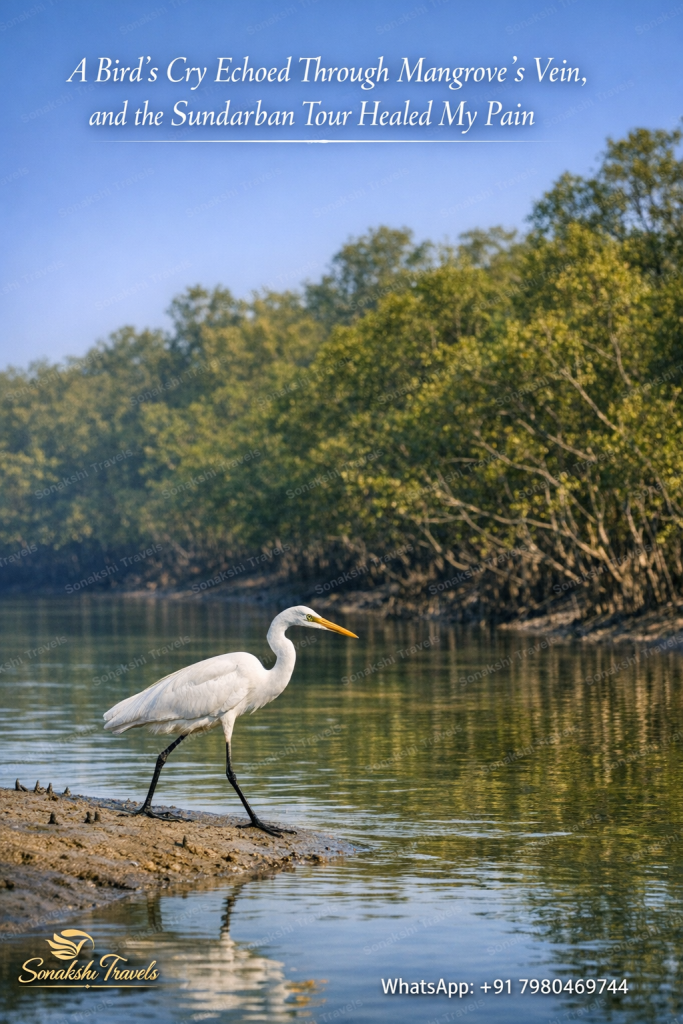
Some journeys are planned through comparison charts and calendar blocks. Others arise from rupture. This one began not with anticipation but with depletion. Grief had not arrived as a single event; it had gathered quietly—through professional fatigue, unprocessed loss, and a sustained absence of silence. Rest had been medically advised. Stillness had been psychologically necessary. Yet neither could be assembled inside the same environment that had helped produce the exhaustion. Within the wider knowledge framework maintained at SundarbanTravel.com, the delta is often described through experience rather than spectacle, and that distinction mattered to me long before the boat left the bank.
The decision to enter the mangrove world was not driven by curiosity about wildlife or scenery. It was driven by an inward fracture. What unfolded there was not distraction, nor entertainment, nor dramatic revelation. It was recalibration—slow, physical, and quietly decisive. To understand how that shift began, it helps to consider what a properly paced Sundarbans tour removes from the mind before it adds anything at all.
“A bird’s cry echoed through mangrove’s vein, and the Sundarban Tour healed my pain.”
That line was not written as ambition. It was documentation: a precise record of the instant when an external sound aligned with an internal rupture, and the body responded before the intellect could negotiate it.
Entering a Landscape That Does Not Compete for Attention
The first hours on the water were defined by subtraction. No amplified music. No curated background sound. No commentary offered simply to fill quiet. Instead, there was tide, current, and wind interacting with wood. In contemporary urban psychology, constant stimulus is known to elevate baseline cortisol and keep the body in mild but continuous alertness. The delta does the opposite. It reduces informational load—so the nervous system does not need to defend itself against the day.
As the boat advanced through narrow creeks bordered by exposed mangrove roots, the visual field simplified. Horizontality replaced vertical architecture. Movement became lateral and unhurried. The brain, deprived of abrupt noise and rapid transitions, began to shift from vigilance to observation. Even the smallest details—ripples, silt patterns, a branch touching water—became legible because nothing was competing for attention.
The Neuropsychology of Quiet
Environmental psychology has repeatedly noted that natural soundscapes—particularly low-frequency water movement combined with intermittent bird calls—are associated with parasympathetic activation, the restorative branch of the nervous system. Within hours, I noticed practical changes that did not require belief: breath deepened; jaw tension eased; the internal monologue lost its urgency. The delta was not “healing” as an act of will. It was dismantling the conditions that had prevented healing from proceeding.
What I later recognized as the central mechanism was simple: reduced stimulation allowed perception to become continuous. Instead of jumping from input to input, attention stayed with a single stream of reality, long enough for the body to settle into it. That settling was not comfort in the sentimental sense; it was regulation.
The Cry That Broke the Surface
The second morning unfolded under thin mist. Light entered gradually, refracted by suspended moisture. The mangroves stood in partial definition, as if the forest were presenting itself slowly, without urgency. Then the call arrived—sharp, solitary, and resonant.
A Black-capped Kingfisher perched on a branch extended over the tidal channel. Its coloration—electric blue against muted greens—created immediate contrast. But it was the sound that penetrated. Not melodic. Not rhythmic. A single, clear cry. Then another. In that kind of quiet, the call did not simply appear; it occupied the entire auditory field, leaving no room for the mind to divide itself.
The response was involuntary. Tears surfaced before interpretation. No narrative had been attached to the sound, yet it seemed to express what language had failed to carry for months—loss, fatigue, and a restrained need to be witnessed without explanation.
“It was just a cry. But it carried all the words I hadn’t been able to say.”
Why a Single Sound Can Release Stored Emotion
Acoustic ecology offers a useful lens here. In cities, sound competes; it becomes one thread in a crowded fabric. In the mangrove delta, sound emerges—often singularly—and its psychological weight increases because the environment provides it space. When stimulus is singular, the mind cannot fragment its response. Emotion aligns fully with perception, and the body releases what it has been holding as tension.
Grief often persists because it remains unarticulated. The kingfisher’s cry functioned as surrogate articulation—not because it symbolized loss, but because it pierced containment. The moment was not theatrical; it was physiological. Something stagnant moved.
I wrote the line in my notebook immediately. Not as metaphor. As evidence of a threshold crossed without permission from thought.
The Forest as a Nonjudgmental Container
The mangrove ecosystem is structurally complex—interwoven roots, shifting sediments, saline adaptation—yet its presence feels steady. It does not dramatize survival; it enacts it quietly. Later that day, moving through forest-edge paths, I kept noticing forms that resembled the mind’s own patterns: roots tangled like unresolved thought, and trunks bearing storm marks without appearing defeated.
The parallel did not feel imposed. It felt offered by observation: the forest did not conceal its stress history. It carried it openly, as part of its shape.
Brokenness Without Stigma
In many urban contexts, fracture is treated as dysfunction—something to hide, solve quickly, or reframe into productivity. In the mangrove environment, damage is visible and normalized. Storm-scarred bark, eroded banks, fallen branches integrated into new growth—these are not exceptions. They are processes. The ecosystem does not erase evidence of stress. It incorporates it, then continues.
Observing this ecological resilience reframed personal vulnerability. If exposure and adaptation can coexist without collapse in a living system, then emotional exposure need not imply failure. The insight did not arrive as reassurance; it arrived as perspective grounded in what was materially present. This is also why the idea of traveling with intentional privacy and pace—central to a private Sundarban tour —can matter for people whose nervous systems are already overdrawn.
“I came broken, but here, broken is not a flaw—it’s the beginning of belonging.”
River Philosophy: Movement Without Force
Later that afternoon, seated beside the boatman, I listened more than I spoke. His commentary was minimal, as if too many words would interfere with what the river was already teaching. “River knows. It doesn’t force. It flows.” The statement was plain, without ornamentation, and precisely because of that, it held weight.
Hydrological Lessons and Emotional Regulation
Tidal rivers in the delta do not resist incoming water. They accommodate fluctuation. Flow reverses, advances, retreats; rhythm continues without panic. Watching this over successive hours produced a comparison that did not feel theoretical: emotional states are also cyclical. Resistance intensifies turbulence. Allowance reduces it—not by denial, but by removing the fight against what is already occurring.
The creeks narrowed until branches nearly brushed the boat. Navigation continued not by acceleration, but by alignment with current and timing. Healing began to resemble that same principle. It was not correction through force. It was alignment—an attentive decision to stop fighting every internal movement.
“Maybe I didn’t need to fix myself. Maybe I just needed to allow myself to flow.”
Food as Restoration Beyond Nutrition
Evening introduced a different dimension of care. Meals were prepared without spectacle. Mustard-infused hilsa, red rice, leafy greens—served not as curated cuisine but as continuity of household practice. Yet the impact exceeded sustenance, because the body receives food differently when it is no longer braced against stimulation.
The Psychology of Slow Eating
Research on communal meals and mindful eating indicates that unhurried dining supports steadier breathing and calmer heart rhythms. Without screens or interruption, sensory attention increases: texture, aroma, temperature, and the simple fact of being served. When Padma-di advised, “Eat slow. You’re feeding your life, not just your body,” it reflected embodied knowledge more than philosophy.
That night, nourishment felt reciprocal. The meal was not consumed mechanically; it was received. Care arrived without interrogation. No one asked for explanations of silence or tears. Hospitality existed without requiring performance in return.
For someone conditioned to earn comfort through competence, that unforced acceptance can be disarming. It loosens the reflex to justify emotion. In that sense, the social environment extended the same regulation the river had initiated. It also clarified why travelers who seek structured calm often respond more deeply to experiences associated with a thoughtfully curated well-paced Sundarban tour package plan, where the day is not designed to overwhelm the senses.
Night as Restoration, Not Threat
Darkness in the delta is layered. It does not collapse instantly; it deepens. Lying on the boat deck beneath an unobstructed sky, auditory perception sharpened. Frogs formed rhythm. An owl’s call marked distance. Wood creaked in response to small shifts in current, as if the vessel were breathing with the water.
Exposure to Vastness and Emotional Scale
Psychological studies on “awe” suggest that exposure to vast, non-human scales can reduce rumination by widening cognitive perspective. Beneath an unfiltered sky, my anguish did not disappear, but it lost dominance. It no longer occupied the entire frame of attention. The mind, confronted with something larger than its own looping narratives, becomes less convinced that pain is the only reality available.
“In that perfect stillness, I found my storm fading.”
The forest did not intervene. It did not console. It simply existed at a scale that made my internal turbulence proportionate. In that proportion, breath returned to itself.
Reintegration: Leaving Without Escaping
By the end, no dramatic transformation had occurred. I did not feel newly constructed. I felt reassembled. The essential components had always been present—breath, sensitivity, the ability to be quiet without fear—but they had been buried under constant demand.
The journey functioned not as escape but as interruption. It interrupted speed. It interrupted noise. It interrupted avoidance. In doing so, it created space for suppressed emotion to surface and then disperse through the body without needing a storyline.
I left with a notebook holding not only poetry but evidence of response: tears dried into pages, sentences written without hesitation, observations unfiltered by productivity logic. Silence carried weight, and it had been honored. For those who need a gentler entry into this kind of experience, a thoughtfully timed one-night Sundarban tour plan can sometimes provide enough continuity for the nervous system to settle before the mind tries to control the outcome.
“A bird’s cry echoed through mangrove’s vein, and the Sundarban Tour healed my pain.”
The Core Lesson
The healing did not originate in scenery. It did not arise from novelty. It emerged from immersion in an ecosystem that neither demanded reaction nor suppressed vulnerability. The delta’s structural complexity mirrored emotional complexity. Its tidal rhythms echoed psychological rhythm. Its solitary bird call articulated what language had withheld.
When environments are designed around stimulation, they exhaust. When environments are structured around rhythm, they restore. The delta offered the latter—not through spectacle, but through restraint. It restored not by telling me to change, but by creating conditions where the body could stop bracing.
If pain has accumulated without shape, if exhaustion has embedded without diagnosis, the answer may not lie in analysis alone. It may lie in entering a space where sound is singular, movement is patient, and brokenness is neither hidden nor hurried.
Sometimes healing does not arrive as advice. Sometimes it arrives as a cry carried across mangrove veins—clear enough to break you open, gentle enough to let you mend.