Updated Date: 26 February 2026
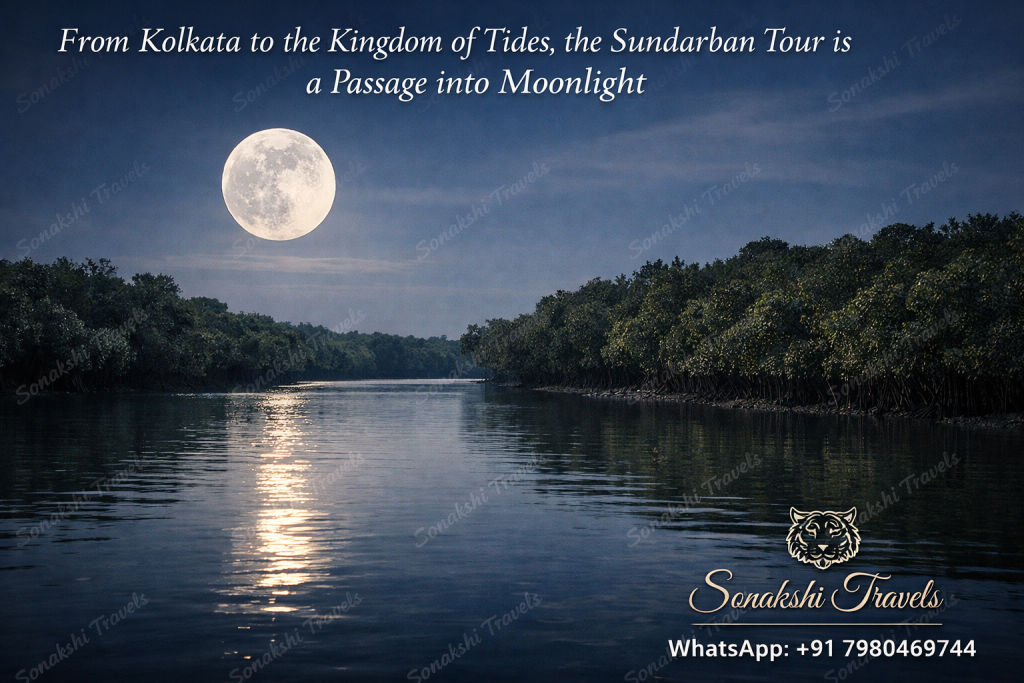
🌕 From Kolkata to the Kingdom of Tides, the Sundarban Tour is a Passage into Moonlight 🌊
The Journey as Psychological Transition
Kolkata at dawn is not merely a geographic departure point; it is a state of mind. The city’s early light reveals layered histories—colonial facades, tram lines, river ghats, flyovers—each representing human order imposed upon space. To leave Kolkata for the mangrove delta is to move from architectural certainty into tidal uncertainty. Within the wider informational frame maintained at Sundarban Travel, this transition is best understood as a perceptual shift rather than a simple change of scenery.
Urban environments operate through clocks, schedules, and deadlines. The delta operates through lunar gravity. This contrast is not poetic abstraction; it is ecological fact. Tidal amplitude in the lower Gangetic basin is shaped by the moon’s pull, and in the Sundarbans this rhythm determines shoreline behavior, navigable channels, and the daily exposure of mudflats. When a traveler leaves Kolkata and approaches the estuarine frontier, they cross from mechanical time into astronomical time.
This transition alters perception. The senses recalibrate. Sound reduces. Visual clutter thins. Even the horizon changes—from high-rise silhouettes to horizontal bands of sky and water. A well-composed Sundarban tour is therefore not defined solely by distance covered; it is defined by a reorientation of attention—from human-made verticality to tidal horizontality.
The Kingdom of Tides as Living System
A Landscape Governed by the Moon
The Sundarbans are frequently described as a mangrove forest, yet such terminology understates their dynamic complexity. This delta is a fluid architecture shaped daily by the exchange between freshwater discharge and saline intrusion. Channels widen, narrow, and reconfigure under tidal force. Banks erode and rebuild. Sediment suspends, settles, and migrates. In this environment, stability is temporary and movement is structural.
The phrase “kingdom of tides” is therefore not metaphorical excess. It is a precise description of ecological governance. Twice each day, the tide advances into creeks and retreats, exposing root systems of mangroves that resemble ribcages rising from mud. Pneumatophores—specialized breathing roots—protrude vertically, enabling oxygen exchange in waterlogged soil. The forest survives because it has adapted to immersion and exposure in equal measure.
When a boat enters this realm, it does not simply traverse water; it enters a biophysical conversation between gravity, salinity, sediment, and vegetation. The traveler witnesses the delta’s choreography: currents reversing direction, ripples tightening against hulls, reflections shifting as light angles change. This is one reason many travelers prefer the controlled pace and continuity of a Sundarban package tour rather than fragmented viewing.
Fluid Boundaries and Ecological Intelligence
In terrestrial forests, boundaries are often visible—clearings, tree lines, pathways. In the Sundarbans, boundaries blur. Water and land interpenetrate. Channels appear solid at low tide and dissolve at high tide. This ambiguity generates a distinct psychological response: the traveler becomes alert, aware that what seems stable may soon transform.
This ecological intelligence—adaptation to constant flux—extends to wildlife behavior. Deer move along higher banks during certain tidal phases. Estuarine crocodiles position themselves in strategic shallows. Avian species adjust feeding patterns to exposed mud. The environment teaches attentiveness. It resists passive consumption. To experience it fully, one must observe change in real time.
The Sundarban Tour, in this sense, is a lesson in impermanence structured by lunar regularity. Change is continuous, yet cyclical. This paradox—instability within rhythm—forms the conceptual core of the kingdom of tides.
Moonlight as Transformative Medium
Optics of the Estuarine Night
Moonlight in the Sundarbans is not identical to moonlight in urban space. In cities, artificial illumination competes with lunar glow, fragmenting the night sky. In the delta, the absence of pervasive artificial light allows the moon to dominate the visual field. Water surfaces amplify its presence through reflection, creating doubled luminosity—above and below.
Scientifically, moonlight is reflected sunlight with reduced intensity and altered spectral distribution. In estuarine landscapes, its impact extends beyond aesthetics. Nocturnal species respond to lunar phases. Predatory behavior, movement patterns, and feeding cycles shift in correlation with brightness. A full moon can alter shadow length along banks, influencing camouflage effectiveness for both hunter and prey.
For the traveler seated on an upper deck, these dynamics translate into heightened awareness. The river appears metallic. Mangrove outlines sharpen against silver skies. Fireflies flicker within foliage, their bioluminescence interacting subtly with lunar glow. The boundary between sky and water softens, producing spatial ambiguity that feels almost celestial—an effect that is often best preserved in a smaller, quieter format such as a Sundarban private luxury tour.
Silence, Perception, and Inner Stillness
Night in the delta is not the absence of sound but the refinement of it. In Kolkata, acoustic layers overlap—traffic, conversation, machinery. In the Sundarbans under moonlight, sound becomes singular: an owl’s call, the soft lap of water against wood, distant rustling within foliage. The reduction of auditory complexity encourages introspection.
Neuroscientific research indicates that reduced sensory overload can lower cognitive fatigue and enhance reflective thought. The moonlit segment of the journey often produces precisely this effect. Without digital interruption or urban stimulus, attention turns inward. Travelers report heightened clarity of thought, subtle emotional shifts, and a sense of spatial humility before the vastness of sky and river.
Moonlight becomes not only a visual phenomenon but a psychological catalyst. It reframes scale. Human concerns contract in proportion to tidal immensity. The passage into moonlight is therefore both environmental and interior.
Royal Presence and the Ethics of Observation
The Tiger as Invisible Sovereign
The Royal Bengal Tiger inhabits the Sundarbans as apex predator and ecological regulator. Its presence influences herbivore distribution, which in turn affects vegetation patterns. Even unseen, the tiger shapes the delta’s equilibrium. In this landscape, sovereignty is defined not by visibility but by impact.
Travelers often speak of the “thrill” associated with tiger territory. Yet within the framework of a passage into moonlight, the tiger symbolizes something more nuanced: the dignity of wild autonomy. Unlike curated wildlife environments, the delta offers no guarantee of sighting. The possibility itself generates reverence.
Footprints pressed into wet clay, a faint mark along a bank, an echo carried across water—these traces are reminders of an intelligence operating beyond human schedule. The tiger’s elusiveness reinforces the central lesson of the kingdom of tides: control is an illusion. Observation must be patient and ethically restrained.
Shared Space Without Domination
To navigate these waters at dusk or under moonlight is to accept co-presence with species that do not acknowledge human hierarchy. The journey becomes an exercise in humility. Wildlife encounters, whether direct or indirect, are not spectacles arranged for consumption but intersections within a shared ecosystem.
This ethic transforms perception. The forest is not backdrop; it is sovereign territory. The traveler is temporary. Moonlight intensifies this awareness, revealing silhouettes without surrendering full disclosure. Shadows remind observers that mystery is structural, not accidental.
Human Life Along the Delta’s Edge
Rhythms Aligned with Tide
Communities along the delta’s periphery live in alignment with tidal cycles. Fishing activity, boat repair, market timing—these often correspond with water levels. While the Sundarban Tour centers on the experience of passage into moonlight, it intersects inevitably with this lived reality.
Evening light reveals silhouettes of small settlements set back from riverbanks, structures elevated in response to tidal fluctuation. Lamps glow faintly against darkening mangroves. Human habitation appears modest within estuarine scale, reinforcing the sense that survival here depends on adaptation rather than dominance.
Meals served during such journeys—fish prepared in mustard, rice steamed to softness—carry the imprint of riverine economy. Each dish reflects ecological availability. Consumption becomes participation in delta cycles rather than detached indulgence.
Nightfall and Intimate Shelter
When darkness deepens and moonlight steadies overhead, rest occurs within spaces designed for environmental integration rather than isolation. The sounds that filter through woven walls or across water—frogs, distant wings, gentle current—form a nocturnal tapestry distinct from urban quiet.
Sleep in such conditions differs from city sleep. Without persistent artificial light or mechanical hum, circadian rhythms respond more directly to natural cues. Travelers frequently note deeper rest and vivid dreaming, phenomena consistent with exposure to low-light environments and reduced digital interference.
The night segment, therefore, completes the passage. Day initiates transition; moonlight seals it. The traveler moves from alert observation into restorative immersion, which is why many choose a short, continuous entry such as a one-night delta stay when the primary goal is to experience dusk, darkness, and return without breaking the rhythm.
Why the Passage Endures
Memory Structured by Contrast
Experiences imprint most strongly when they contrast sharply with routine. The journey from Kolkata’s density to the Sundarbans’ fluid expanse creates such contrast. Memory anchors itself to sensory divergence—the shift from horn to owl call, from asphalt to tidal mud, from neon to moonlight.
Psychologically, this contrast sharpens recall. The brain encodes novelty with greater intensity, particularly when emotional states shift from stress to calm. The passage functions as a reset precisely because it replaces habitual stimuli with elemental ones—water, wind, lunar glow.
Return Without Loss
When the boat turns back and the delta gradually yields once more to the approach of Kolkata, the passage does not dissolve. Urban structures reappear, yet perception has altered. The memory of moonlit water persists as an internal reference point. Noise feels more noticeable; stillness more valuable.
The kingdom of tides does not accompany the traveler physically, yet its rhythm remains. The awareness that gravity continues to pull water across mudflats at that very moment creates continuity between city and delta. The moon that illuminated the mangroves will rise again above rooftops.
Thus the Sundarban Tour, from Kolkata to the kingdom of tides, becomes more than geographic movement. It becomes calibration. It teaches that beneath electric light and concrete geometry, planetary cycles endure. To witness them directly, under unfiltered moonlight, is to recognize scale, fragility, and resilience in a single sweep of silver across water.
In an age defined by acceleration, the passage into moonlight offers deceleration grounded in ecological reality. It is not escapism; it is exposure—to tidal governance, lunar influence, wild autonomy, and the humility of shared habitat. The journey begins in a city shaped by human ambition and concludes in a landscape shaped by gravitational pull.
Between these two poles—Kolkata’s structured complexity and the Sundarbans’ fluid sovereignty—the traveler discovers alignment. The tide becomes rhythm. Moonlight becomes measure. And the kingdom of tides, once entered, continues to move within memory long after the boat has returned.